Foreign ministry says two leaders discuss economic issues, broader implications of regional instability
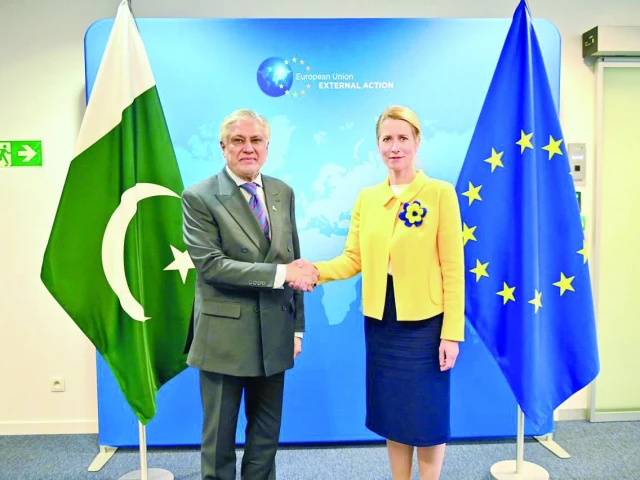
Deputy Prime Minister Ishaq Dar shakes hands with EU Vice President Kaja Kallas in Brussels. Photo: APP
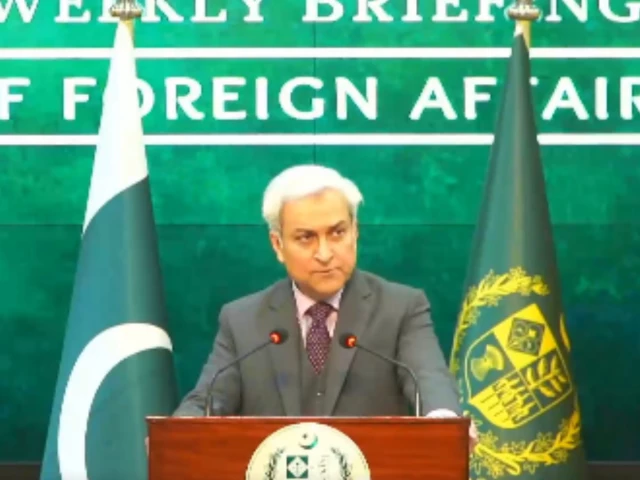
European Union Vice President Kaja Kallas appreciated Pakistan’s continued constructive and facilitative role in promoting regional peace and stability in a call with Deputy Prime Minister and Foreign Minister Ishaq Dar on Thursday.
According to the Ministry of Foreign Affairs (MOFA), both discussed the evolving regional situation, including its economic and broader implications, and agreed to remain in close contact.
Read: Leaders unite in praising Pakistan’s peace role
Kaja appreciated Pakistan’s continued constructive and facilitative role in promoting regional peace and stability,” it said.
It added that FM Dar reaffirmed Pakistan’s sustained commitment to promote dialogue and engagement in this regard.
“FM Dar also commended the recent successful convening of the EU-Pakistan Business Forum in Islamabad, underscoring its role in strengthening partnerships and unlocking new opportunities for businesses,” said the statement.
Deputy Prime Minister/Foreign Minister Senator Mohammad Ishaq Dar @MIshaqDar50 spoke today with EU Vice President/High Representative Kaja Kallas @KajaKallas.
They discussed the evolving regional situation, including its economic and broader implications. EU HR/VP appreciated… pic.twitter.com/muAoTkaafq
— Ministry of Foreign Affairs – Pakistan (@ForeignOfficePk) April 30, 2026
On April 28, the foreign ministers of the United Kingdom, Canada and Egypt discussed the latest developments in the regional situation and emphasised the importance of dialogue and diplomacy for peace during separate telephone calls with Dar.
FM Dar has received unprecedented international recognition for his diplomatic leadership, as Pakistan positioned itself at the centre of high-stakes mediation efforts during the escalating Iran-US-Israel crisis.
Over the past weeks, senior officials and influential voices from more than ten countries, including Saudi Arabia, Iran, the US, China, Turkiye, Azerbaijan, Bahrain, and Uzbekistan, have publicly acknowledged Dar’s role in facilitating ceasefire negotiations.
Pakistan emerged as a central facilitator in the sensitive diplomatic track, positioning itself as an “honest broker” amid sharply polarised positions between Washington and Tehran.
After 40 days of airstrikes, US and Iranian negotiators opened talks in Islamabad earlier this month, again focused on the familiar trade‑off of nuclear restrictions for economic relief. When American and Iranian negotiators met in Islamabad, the US proposed a 20-year suspension of all Iranian nuclear activity, while Iran suggested a halt of three to five years, according to people familiar with the proposals.
The second round of talks did not yield any results as, a day earlier, Iranian FM Araghchi visited Islamabad. It was his second visit in two days. However, US President Donald Trump cancelled a planned visit to Islamabad by his envoys Steve Witkoff and Jared Kushner.