‘Essential to turn need for reform into concrete roadmap’ with abolition of veto privilege at centre says Erdogan
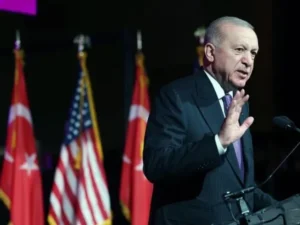
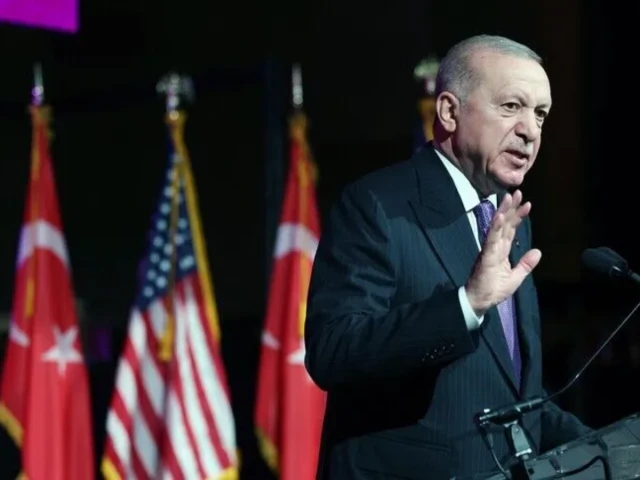
A photo of the President of Türkiye, Recep Tayyip Erdogan. PHOTO: ANADOLU
Turkish President Recep Tayyip Erdogan called for comprehensive reform of the UN Security Council, including the removal of the veto power held by its permanent members, arguing that the international system must better reflect today’s global realities.
In an article for Bloomberg titled “The Quest for Global Justice in a Changing World,” Erdogan said recent crises, including pandemics, energy shocks, disruptions to supply chains and regional conflicts, had demonstrated the limits of leaving solutions to global challenges to the decisions of a handful of capitals.
Stressing that global decision-making mechanisms must now adapt to today’s conditions, he said the UN Security Council continues to reflect the structure established after World War II.
Erdogan said “a more effective, fair and accountable” system of representation was necessary and called for broader participation in global decision-making.
He said Türkiye’s call that “the world is bigger than five” should be understood as an appeal for a broader distribution of responsibility in the international system.
Read: US veto blocks UN Security Council call for Gaza ceasefire
Erdogan has long pushed for reforms to the UN, often using the slogan: “The world is bigger than five,” which refers to the Security Council’s unrepresentative membership.
For years, the Council has faced claims that its five veto-wielding members — the US, the UK, France, Russia and China — command disproportionate influence.
“It is essential to turn the need for reform into a concrete roadmap,” Erdogan said. “At the centre of this roadmap should be the abolition of the veto privilege.”
He argued that simply adding new permanent members to the Security Council would not resolve the concentration of decision-making power in the hands of a small number of countries.
According to Erdogan, reform should instead be based on the principle that no country should have the permanent ability to block the will of the majority of the international community.
‘Greater role for General Assembly’
The president also called for a new balance between the UN Security Council and General Assembly.
He proposed strengthening the powers of the General Assembly and creating a Security Council without permanent membership, with council members elected by the General Assembly for fixed terms.
Under the approach outlined by Erdogan, countries seeking another term would have to regain the confidence of a majority of General Assembly members through elections.
“Representation and accountability of the Security Council before the General Assembly should be enhanced,” he said.
He argued that the international order of the future could not be built by preserving the hierarchies of the past.
“Developments over the last quarter century, which is a relatively short period in human history, have shown that no balance of power and no international order is permanent,” he said.
Read More: Erdogan says Turkiye would consider full membership of China- and Russia-led security bloc
Erdogan said new centres of power had emerged in areas ranging from the economy and security to technology and diplomacy, while international institutions had failed to adapt to these changes at the same pace.
Wars, the climate crisis, irregular migration and economic vulnerabilities have underscored the importance of strong institutions, resilient economies and effective defence capabilities, he added.
The president pointed to the growing importance of secure and sustainable trade, logistics, transportation and energy corridors.
Erdogan said Asia’s economic weight was increasing, while African countries were seeking stronger representation consistent with the continent’s potential.
Calls for greater fairness in global economy
He also said developing countries were increasingly voicing their own priorities and argued that regional problems could not always be resolved through methods determined from outside.
“Approaches based on the will of the countries concerned, local conditions and common interests will produce more lasting and stable results,” Erdogan said.
He called for countries with the diplomatic capacity, economic resources and ability to communicate with different sides to assume “more active roles” in promoting peace and stability.
Also read: Trump says he disagrees with UK’s Starmer on Palestinian state
Erdogan also addressed economic inequalities, saying expectations that globalisation would broadly distribute prosperity had not been fully realised.
He said income disparities had deepened, while technological and economic dependencies had become new areas of competition.
“For global justice to be achieved under these changing circumstances, responsibilities must be shared fairly,” Erdogan said, adding that developing countries’ right to development and access to the financing they need should be secured.
He also argued that the international system must better account for changing economic and political realities across different regions.
Erdogan said Türkiye would continue using its extensive international relations and experience in multilateral diplomacy to support efforts to reform the international system.
“We support efforts to abolish the veto privilege, give elected members greater weight in decision-making processes and strengthen the role of the General Assembly,” he said.
He said cooperation among countries from different regions around common principles would strengthen the legitimacy and representative capacity of the international system.
“Permanent peace in today’s world cannot be achieved by multiplying blocs that are disconnected from one another and do not communicate with one another,” Erdogan said.
“For a more just world, we must bring together the experience, capacity and will of different regions on common ground.”
Erdogan said Türkiye would continue to assume its responsibility in efforts to reform the international system, citing the country’s state tradition, diplomatic capacity and relations with different regions.