


From Rihanna’s yellow spectacle to Doja Cat’s feline tribute, viral looks redefine fashion’s biggest night
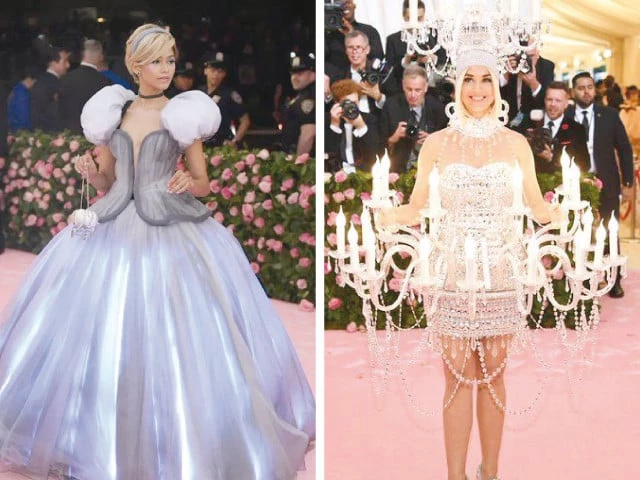
Fashion statement: Zendaya as Cinderella and Katy Perry in chandelier look. Photos: X
In the rarefied world of haute couture, the Met Gala has long stood as fashion’s most exclusive stage, yet in the age of social media, its influence stretches far beyond velvet ropes and museum halls into the relentless churn of internet culture.
What once unfolded as a carefully curated parade of avant-garde design now doubles as a global meme factory, where a single outfit can ricochet across platforms within minutes, reshaped by humour, parody and mass participation.
As anticipation builds for the 2026 edition, past appearances continue to echo online, often with a life entirely detached from their original artistic intent. Few moments capture this shift more vividly than Rihanna’s sweeping yellow gown by Guo Pei, a creation that instantly transcended fashion critique to become internet shorthand for excess and drama.
Similarly, Kim Kardashian’s Thierry Mugler “wet look” sparked a wave of commentary that blurred admiration with satire. The illusion of water droplets clinging to fabric prompted jokes about stepping out of a storm, illustrating how even the most meticulously crafted designs invite reinterpretation once released into the digital wild.
The gala’s theatricality has consistently lent itself to viral reinvention. Katy Perry’s chandelier-inspired outfit, glowing with literal illumination, was swiftly recast online as festive decor, while Lady Gaga’s multi-layered striptease performance on the carpet became a ready-made metaphor for rapid emotional shifts and online personas.
More surreal still was Jared Leto carrying a replica of his own head, an image that proved irresistible to meme-makers who inserted the prop into imagined scenarios ranging from boardrooms to family dinners.
In contrast, Zendaya’s Cinderella-inspired transformation – complete with a glowing gown – merged fairytale fantasy with technological spectacle, fuelling comparisons that bridged fashion and innovation.
Recent years have only sharpened this interplay. Doja Cat’s homage to Karl Lagerfeld’s cat demonstrated how strict thematic dressing can still resonate widely online, particularly when it leans into whimsy and character. Each of these moments underscores a broader reality: the Met Gala is no longer judged solely by critics or insiders, but by the speed and creativity with which audiences reframe it.
The 2026 gala, themed “Costume Art” with a dress code of “Fashion Is Art,” is poised to deepen that dialogue. With references expected from Renaissance paintings to Impressionist palettes, the red carpet may resemble a living gallery – though history suggests it will just as quickly become raw material for digital reinvention.
Behind the spectacle lies the event’s enduring purpose: raising funds for the Metropolitan Museum of Art’s Costume Institute, even as ticket prices soar to reported figures of $75,000 per seat. Yet for all its exclusivity, the gala’s true reach is democratised online, where millions engage not as spectators but as participants in an ongoing cultural remix.
In that sense, the Met Gala’s most lasting legacy may not hang in museum archives but circulate endlessly in memes – fleeting, irreverent and, in their own way, a form of modern folklore.