Global lender pushes for tariff cut to 6% by 2030, end of protection for assemblers
ISLAMABAD:
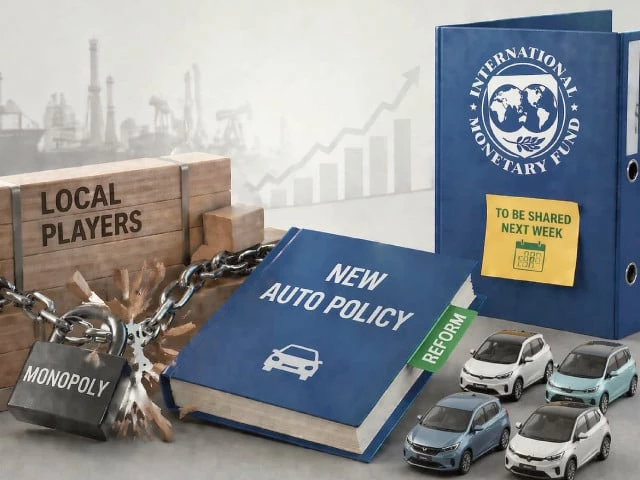
The International Monetary Fund (IMF) will vet the new auto policy before it is approved by Pakistan’s federal cabinet, as the global lender pushes to open the sector for foreign players by lowering net weighted average tariffs to single digits.
The new auto policy must end protection for local car assemblers and parts manufacturers and bring down import tariffs to a net weighted average of 6% by 2030 to align with the National Tariff Policy. The policy may target enhancing sector exports to $3 billion and increasing vehicle production to over 500,000 units in the next five years.
Government sources told The Express Tribune that Pakistani authorities have “assured” the IMF that they will share the draft Automobiles and Auto Parts Manufacturing Policy (2026-31) with the fund by next Thursday, April 30. The draft will be shared even before it is approved by the federal cabinet, suggesting that the IMF may have apprehensions about the continuation of existing protection for current automobile assemblers. According to the commitment given to the IMF, the new auto sector policy will be shared with the fund by end-April 2026, ahead of its cabinet approvalGovernment sources said. Pakistan has committed to continuing to reduce barriers to international trade, including through the National Tariff and auto policies.
The government has already shared the broad parameters of the new policy, which include the complete phased elimination of additional customs duties and regulatory duties, along with significant reduction in customs duties. On parts, duties may be cut by half in five years. On completely built units, duties may be reduced by 15% to 20% on vehicles with engine capacity of over 1,000cc.
The government has already opened the import of used vehicles under IMF instructions. However, a law to regulate these imports by only well-established companies is pending parliamentary approval.
Pakistan’s automobile sector remains heavily protected, and the government admits that the sector could not achieve true localisation, exposing customers to the adverse impact of rupee-dollar devaluation. The entry of new players in recent years has offered some better options, but overall customer satisfaction remains poor.
Sources working on the new policy said it would be performance-driven, and an internationally benchmarked roadmap will be implemented for the structural transformation of the highly protected sector. The new policy will be aligned with the New Energy Vehicle Policy 2025-30 and the National Tariff Policy 2025-30.
All three main statutory regulatory orders (SROs) 655, 656 and 693 will be gradually phased out, and tariffs will be aligned with IMF commitments. The National Tariff Policy (NTP) 2025-30 aims to simplify Pakistan’s tariff regime by rationalising existing duties and maintaining the net weighted average below 6% by the end of 2030.
Moderate protection is planned for non-localised completely knocked down (CKD) cars. For localised CKD, additional customs duties may be gradually reduced across all categories, stabilising at a minimum level by 2030-31. Fiscal incentives may be linked to localisation performance, with localisation of parts planned to increase from less than half to about two-thirds of total production.
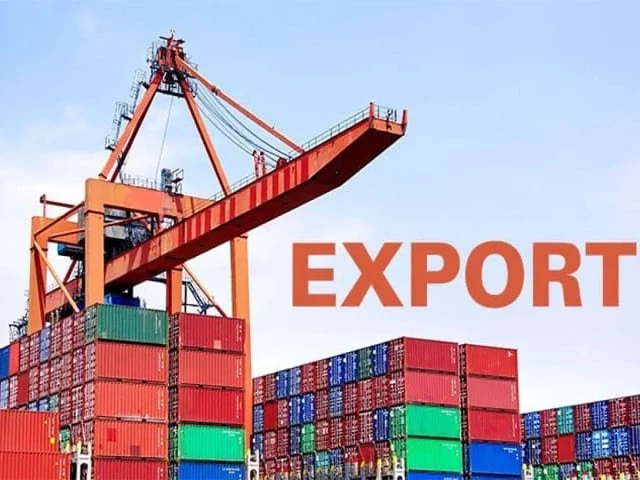
The sources said the government wants to ensure adequate protection for domestic investment, so completely built unit duties may not be reduced below 40% for any category. However, regulatory and additional duties on imported cars may be reduced or abolished over five years. The government is planning a performance-linked incentive scheme based on verified domestic value addition, export volumes and successful adoption of advanced automotive technologies. It aims to increase sector exports from a low of $300 million to $3 billion by 2031, though this remains challenging without compelling assemblers to enhance vehicle quality to international standards.
Compared with an estimated 500,000 production capacity, annual sales range from 150,000 to 180,000 units. The government aims to enhance production to over 500,000 units by 2031. The success of the new policy will be linked to achieving performance indicators and enhancing exports, said sources. Used-car imports have already captured about one-fourth of the domestic market, a share that industry projections warn could surge to 50% if policy distortions persist.
Sources said there was no major emphasis on forcing localisation on the assemblers, and the Engineering Development Board could not effectively play its role. Localisation remains limited to basic parts, restricting high-value, complex components critical for modern vehicles, including engines, transmissions, sensors, engine control units (ECUs), battery management systems (BMS) and advanced electronics, which remain almost fully imported.According to the Engineering Development Board, average localisation in passenger cars is 58% in Pakistan compared with 80% in India until a year ago.
The auto policy will also protect incentives for electric vehicles. Initial plans suggest a fiscal slope to incentivise the manufacturing of new energy vehicles (NEVs) and their core components, accelerating the technological leapfrog required for the 30% NEV adoption target. Non-localised parts specific to NEVs will attract 1% customs duty for two years and 5% from the third year onwards. Sales tax on imports of NEV-specific parts may be exempted for two years and charged at 50% of the levied rate from the third year onwards.