‘Goal is now to see lasting end to war…permanent freedom of navigation in Hormuz without tolls,’ says von der Leyen
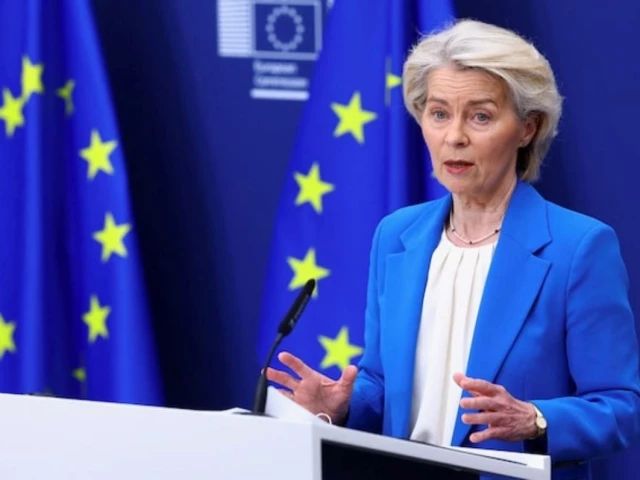
European Commission President Ursula von der Leyen speaks at a press conference in Brussels, Belgium, April 13, 2026.PHOTO: REUTERS
EU Commission chief Ursula von der Leyen said the bloc is working toward a lasting end to the Middle East conflict, stressing the need to restore maritime security in the Strait of Hormuz.
Addressing the European Parliament, von der Leyen said a recent lull in fighting offers an opportunity to advance diplomatic efforts, including sustaining a ceasefire involving Iran and Lebanon.
“Our shared goal is now to see a lasting end to the war, and this includes restoring full and permanent freedom of navigation in the Strait of Hormuz without tolls,” she said. “And it is equally clear that any peace agreement will have to address Iran’s nuclear and ballistic missile program,” she added.
Also Read: Iran’s Guards seize wartime power, blunting supreme leader’s role
Von der Leyen said EU leaders had met regional partners, including Egypt, Lebanon, Syria, and Jordan, as well as the Gulf Cooperation Council’s secretary-general, to coordinate efforts toward de-escalation and stability.
She cautioned, however, that the conflict’s economic fallout could persist “for months or even years,” particularly in energy markets, as disruptions in key shipping routes risk driving up global prices.
Highlighting the impact, von der Leyen said Europe’s fossil fuel import bill had increased by more than €27 billion ($31.6 billion) in just 60 days of conflict, “without one single molecule of energy in addition.”
She said the crisis underscored the EU’s vulnerability to imported fossil fuels and called for accelerating the transition to domestically produced energy.
Read More: Trump says King Charles does not want Iran to have nuclear weapon
“We must reduce our overdependency on imported fossil fuels, and we must boost our homegrown, affordable clean energy supply,” she said, pointing to renewables and nuclear power as key pillars.
Von der Leyen also emphasised the need for stronger coordination among EU member states on fuel reserves and gas storage, as well as targeted support for vulnerable households and industries to avoid repeating costly, untargeted measures seen during the previous energy crisis.
She added that electrification and energy efficiency would be central to reducing demand and shielding Europe from future shocks, noting that countries with higher shares of low-carbon energy have been less affected by price volatility.
The commission president also said the EU would present an electrification action plan by the summer, alongside broader efforts to modernise energy infrastructure and strengthen economic security.