

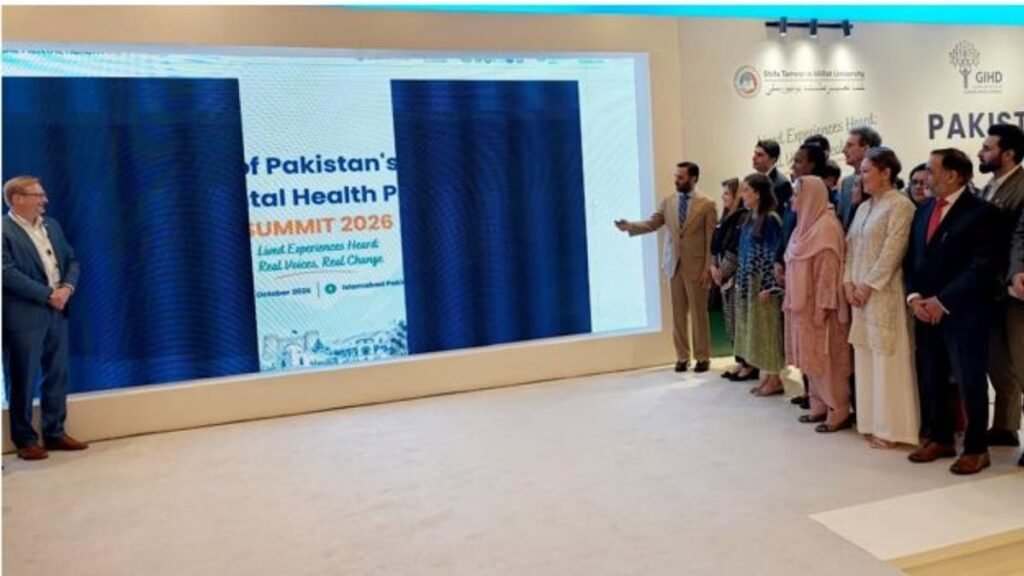
Pakistan has launched a new national mental health policy aimed at expanding access to care for millions of people, as the country hosts a two-day Global Mental Health Summit in Islamabad.
The National Mental Health Policy 2026-2035 was launched by the government in partnership with the World Health Organization (WHO), the United Nations Children’s Fund (UNICEF) and the Global Institute of Human Development (GIHD), Shifa Tameer-e-Millat University (STMU).
Under the leadership of the Ministry of National Health Services, Regulations and Coordination (MoNHSRC), the summit, being held on 1 and 2 October 2026, brings together about 800 participants, including mental health experts, academics, policymakers and representatives of international development organizations.
The government says the policy will focus on expanding mental health services through schools, primary healthcare and communities, with an emphasis on early intervention and access to care.
The WHO estimates that about 32.4 million people in Pakistan need mental health support. However, only around 5 percent of the population has access to mental health services, leaving a treatment gap of about 95 percent.
The country also faces a shortage of trained mental health professionals. Pakistan has around 0.19 psychiatrists per 100,000 people, compared with an average of seven per 100,000 in high-income countries, according to the WHO.
Federal Health Minister Syed Mustafa Kamal described mental health as an emergency and called for greater cooperation between government departments and other institutions.
Everybody has to play their role to create a safe and healthy space to live for the people of this country,” said Federal Health Minister Syed Mustafa Kamal.
“We really have to work hard. This conference needs to lead to action, and we are thankful to all national and provincial institutions, authorities, and international and national partners for working together to address this important crisis.”
Minister of State for Health Dr Malik Mukhtar Ahmad Bharath said the policy would seek to bring mental healthcare closer to families by integrating services into schools, primary healthcare and communities.
WHO Director-General Tedros Adhanom Ghebreyesus said investment in mental health could also bring economic benefits. He said every dollar invested in addressing conditions such as depression and anxiety could generate four dollars in returns through improved health and productivity.
WHO is committed to working with Pakistan and all countries to ensure that everyone has access to the mental health support they need, no matter where they live or who they are; because there is no health without mental health.”
UNICEF Representative in Pakistan Pernille Ironside called for greater attention to children and adolescents, including prevention, early identification and access to care.
As climate change and digital environments increasingly affect young lives, mental health resilience must be part of building a healthier, more resilient generation,” said UNICEF Representative in Pakistan, Pernille Ironside.
Pakistan says it aims to establish the Global Mental Health Summit as a major international platform for mental health policy, research, innovation and partnerships, while promoting more equitable and climate-resilient mental health systems.