
Iran set to receive up to 400 Chinese-made air-defence missile systems within weeks amid efforts to rebuild forces
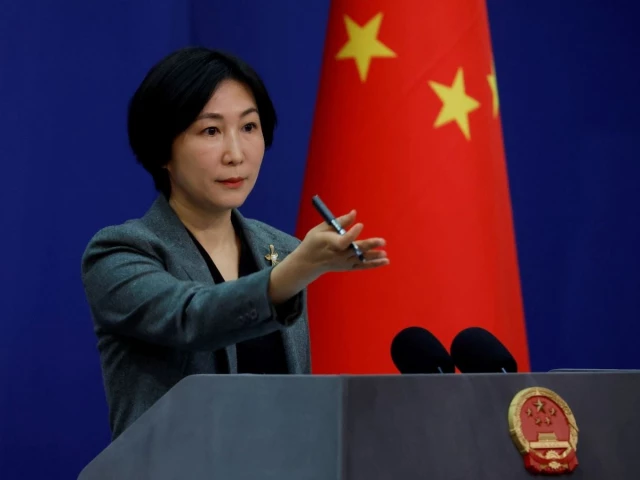
Chinese Foreign Ministry Spokesperson Mao Ning attends a news conference in Beijing, China, February 3, 2023. REUTERS
Chinese Foreign Ministry spokesperson Mao Ning said at a regular press briefing on Thursday that a media report claiming China plans to supply 400 SAMs (surface-to-air missiles) to Iran is not true and has no factual ground at all.
China has made its position clear on relevant issues on multiple occasions, Mao said, noting that China always works for peace and the end of the conflict.
Two days ago, several media outlets claimed that Iran is expected to receive its first shipment of up to 400 Chinese-made shoulder-fired air-defence missile systems within weeks, three sources familiar with the deal told Reuters, as Tehran seeks to rebuild its military capabilities following months of conflict with the United States and Israel.
The deal, valued at $60 million to $70 million, represents one of Iran’s largest known efforts to strengthen its short-range air-defence capabilities since the war exposed weaknesses in its ability to protect military facilities and strategic infrastructure.
The contract covers the purchase of between 300 and 400 man-portable air-defence systems (MANPADS), including China’s QW-12 and FN-16 missile systems, the sources said.
The agreement was signed with Zhongqing Baoshang International Investment, a Hong Kong-based company that the sources described as an intermediary between Iranian officials and the Chinese supplier.
Iran seeks to rebuild air defences
The sources spoke on condition of anonymity because of the sensitivity of the matter. Iran’s Foreign Ministry did not immediately respond to a request for comment.
Also Read: Egypt confirms drone caused fire on two gas vessels at Damietta
China’s Foreign Ministry rejected the report, saying: “The relevant reports are completely groundless. China has consistently played a role in promoting peace and ending the conflict.”
Asked about the deal during a regular press briefing in Beijing, Chinese Defence Ministry spokesperson Jiang Bin said he was “not familiar with the relevant situation”.
Beijing-based Zhong Qing Bao Shang Group, the parent company of Zhongqing Baoshang International Investment, did not immediately respond to a request for comment.
Iran has been seeking to restore its defences after months of fighting in which the United States and Israel targeted facilities linked to its missile, drone and air-defence programmes. Tehran responded with waves of ballistic missiles and drone attacks.
The conflict exposed the difficulty of protecting fixed military sites and strategic infrastructure against advanced aircraft and precision-guided weapons.
Washington suspended two weeks of bombardment on Saturday, but US President Donald Trump said strikes could resume if negotiations fail to end the five-month-old conflict, which has technically remained under a ceasefire since April.
Trump says China involvement would be surprising
Responding to the Reuters report, Trump said it would be surprising if Iran received such equipment from China, given what he said were assurances from Chinese President Xi Jinping that Beijing would not intervene on Tehran’s behalf.
“I mean, things like that happen, but that would be surprising. He (Xi) told me very strongly he wouldn’t partake, but he knows I’d be quite disappointed,” Trump said on Wednesday.
The delivery of hundreds of MANPADS would significantly expand Iran’s inventory of short-range air-defence weapons and highlight growing military cooperation between Tehran and Beijing.
The sources cautioned that although the agreement had been signed, delivery schedules, quantities and other implementation details could still change.
China and Iran explore alternative routes
Iran has invested heavily over the past two decades in missiles, drones and radar systems. Military experts say portable air-defence systems are valuable because they can be quickly deployed, operated by small teams and frequently relocated, making them harder to target than fixed defence batteries.
A European security source said authorities in his country were aware of several contracts under discussion involving possible sales of QW-series MANPADS to Iran, including QW-12, QW-18 and QW-19 systems.
Read More: IRGC says it hit Kuwait and Jordan, destroyed three US F-35s
A Middle Eastern security source said Iran had sought to purchase QW-12 and QW-18 missiles but was unaware that a final agreement had been completed.
The QW-12 and FN-16 are shoulder-fired, infrared-guided surface-to-air missile systems designed to engage low-flying aircraft, helicopters and drones.
Defence analysts say the QW-12 is less advanced than newer QW variants such as the QW-18 and QW-19, but it could still provide an effective layer of protection against drones and low-altitude targets.
Two Western intelligence sources and an Iranian official said Tehran had also explored overland routes for transporting Chinese military supplies and dual-use components to reduce the risk of disruption.
The procurement highlights Iran’s continued reliance on a mix of domestic weapons production and foreign suppliers despite years of sanctions and restrictions on defence imports.
Reuters previously reported that Iran was close to securing a separate agreement with China to acquire anti-ship cruise missiles, although it could not determine whether that deal was completed.