US Treasury chief says Washington has mapped Iran’s networks and financial channels used to evade sanctions
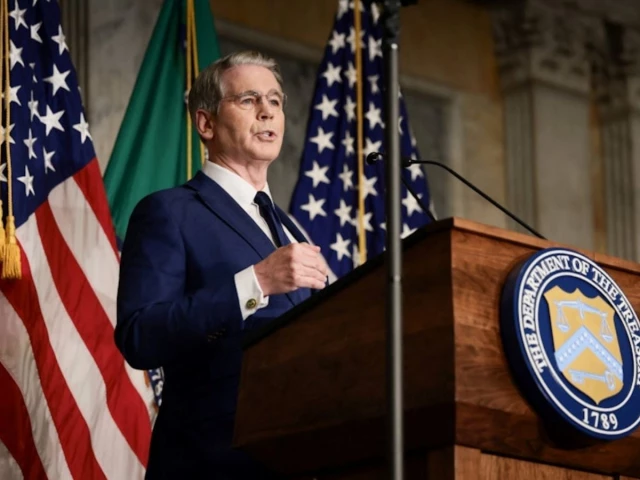
Bessent at the Treasury Department in Washington, August 24, 2026. REUTERS
The US has launched what Treasury Secretary Scott Bessent described as an unprecedented economic campaign aimed at cutting Iran off from the global financial system and disrupting the revenue networks Washington says sustain Iran.
Dubbed Operation Economic Outcast, the campaign expands sanctions and secondary-sanctions risks across key sectors of Iran’s economy while targeting companies, individuals, vessels and intermediaries involved in oil revenues, military procurement, cyber operations and sanctions evasion.
In the Second World War, D-Day marked the historic beginning of a campaign with our allies to target and drive the enemy from its positions, including those in third countries. Today, in that same spirit, we are launching an economic onslaught against Iran’s financial connections… pic.twitter.com/1fLyobUucu
— Treasury Secretary Scott Bessent (@SecScottBessent) August 24, 2026
Speaking at a news conference Monday, Bessent said the initiative, directed by US President Donald Trump, represents a shift from containing Iran to attempting to fundamentally undermine its economic ability to operate internationally.
“Our objective is to sever every economic lifeline that sustains this tyrannical regime until Tehran stands alone,” Bessent said.
The Treasury chief said the US had mapped the networks and financial channels used by Iran to generate revenue and evade sanctions and warned that Washington would pursue them internationally.
Five critical sectors targeted
The new campaign expands the scope of potential secondary sanctions to five sectors that Washington considers critical to Iran’s ability to sustain its economy: digital assets, technology, gold, aviation and shipping.
In a press release on Monday, the Treasury Department said it had also sanctioned nearly 60 entities, individuals and vessels across multiple jurisdictions. The targets include networks allegedly involved in illicit nuclear and missile technology procurement, cyber operations and the generation and movement of oil revenues.
The measures are designed not only to target Iranian entities directly but also to pressure foreign companies, financial institutions, shipping operators and intermediaries that continue to conduct business with Tehran.
Bessent described the approach as a “zero-leakage” policy, saying Washington would seek to prevent Iran from finding alternative financial channels to rebuild its capabilities.
Read More: US expands sanctions in what it calls an ‘economic onslaught’ on Iran and its partners
“Beginning today, the actions of Treasury and other agencies will tighten the noose and block every potential source of revenue that funds the IRGC (Islamic Revolutionary Guard Corps) and the evil Iranian regime,” he said.
The campaign also includes additional guidance on sanctions risks associated with shipping through the Strait of Hormuz as well as the suspension of several general licenses that had permitted certain transactions involving Iran.
Warning to Iran’s international partners
A central element of the Operation Economic Outcast is the threat of secondary sanctions against foreign actors that continue to facilitate Iran’s economic activity.
Bessent said US officials from the Treasury, State Department, and military are engaging with governments around the world and informing them that Washington expects action against activities it has identified as supporting Iran.
“We are giving everyone the opportunity to remedy bad behavior,” Bessent said, while warning that the opportunity would not remain open indefinitely.
He said every country would receive a defined timeline to shut down identified Iran-related activities and that the Treasury would act unilaterally if governments failed to comply.
“The United States expects action,” Bessent told reporters. “We do not have infinite patience here.”
“No one is above the reach of US sanctions,” Bessent said when asked about potential action against Chinese banks involved in financing Iranian oil imports.
Bessent refrained from naming specific governments or publicising timelines for action but said they are being communicated behind the scenes.
“We’re not going to name names. We’ve already seen some results, and I am confident the president (Trump), as you all know, is quite persuasive,” he said.
Oil networks, financial system in crosshairs
Iran’s petroleum trade is a major focus of the campaign. The US says Iranian oil revenues are moved through networks involving brokers, shell companies, intermediaries and vessels operating across several jurisdictions.
The Treasury said one of its targets is a network of companies and “shadow fleet” vessels operating in locations including the UAE, Hong Kong, China, Singapore, Switzerland, and Europe to transport Iranian oil and channel revenue to the IRGC-Quds Force and other Iranian elements.
The campaign also targets the financial infrastructure that Washington says enables sanctions evasion and money laundering.
“Any entity that facilitates money laundering on behalf of Iran will be removed from the US dollar system. The clock just started ticking,” Bessent said.
He also said he expected a major financial institution to be sanctioned by the end of the week, without identifying the institution.
The US says blocked persons’ property and interests in property under US jurisdiction will be frozen, while US persons will generally be prohibited from engaging in transactions involving designated entities unless authorised by the Treasury Department’s Office of Foreign Assets Control.
Iran faces ‘clear choice,’ Bessent says
Bessent framed the campaign as a choice between economic isolation and a potential return to international economic integration.
Also Read: Trump says Iran executions are a ‘humanitarian crisis of epic proportions’
“Iran now faces a very clear choice, with only two paths before them: complete global isolation and a subsistence economy or a path back to normalcy with an opportunity to rejoin the global economy,” he said.
The Treasury secretary characterised the campaign as an “economic D-Day,” invoking the Allied invasion of Nazi-occupied France during World War II to describe what he presented as the beginning of a sustained campaign against Iran’s economic networks.
The initiative comes amid a broader US-Iran confrontation and follows claims by the US administration that American military operations have severely damaged Iran’s military and nuclear infrastructure. Washington says the economic campaign is intended to prevent Tehran from rebuilding those capabilities and financing activities the US considers destabilising.
The Treasury, however, emphasised that sanctions are intended to change behaviour rather than simply punish those targeted.
“The ultimate goal of sanctions is not to punish, but to bring about a positive change in behavior,” the department said.
Bessent similarly presented reintegration into the global economy as an alternative to continued confrontation while warning governments and businesses that perpetuating economic ties with Tehran could bring them within the reach of US sanctions.