
The real number of children sexually exploited by organised grooming gangs in the UK remains unknown
Over the decades, the United Kingdom (UK) has grappled with a range of organised crimes — from county lines drug networks to human trafficking — that have exposed systemic failures in law enforcement, local authorities and social services.
Among the cases that drew sustained public and political attention was the issue of organised child sexual exploitation, particularly cases involving grooming gangs.
Since the early 2010s, child sexual exploitation cases surfaced in towns such as Rotherham, Rochdale, Telford, Oxford and Huddersfield, leading to convictions, official inquiries and sustained scrutiny of how police, local authorities and safeguarding institutions responded to vulnerable children. Survivors, campaigners and political figures have continued to argue that institutional failures prevented the full scale of abuse from being recognised.
Estimates from a 2014 report suggested the number of victims who may have been exploited by men, primarily of Pakistani heritage, in such cases is at least 1,400.
In 2025, the issue once again hit the headlines after US tech billionaire Elon Musk accused UK Prime Minister Keir Starmer of complicity for his role as the then head of the Crown Prosecution Service. Later that year, a Manchester court sentenced seven men to prison terms ranging from 12 to 35 years for systematic sexual abuse of two teenage girls in Rochdale between 2001 and 2006.
In the autumn of 2025, the National Crime Agency (NCA) also launched Operation Beaconport, a project tasked with unearthing failings to tackle grooming gangs. A BBC report quoted the deputy director of the NCA as saying that “human error” may have led to criminal cases involving alleged grooming gangs being dropped.
“We’ve seen in some cases that those investigations haven’t followed what we would characterise as proper investigative practice; actually, that would have contributed to the no further action decision,” he said.
Since then, public concern has increased, with renewed calls for a national inquiry and debate over whether prior investigations adequately captured the extent of exploitation.
However, recently, misinformation has spread based on reality — the numbers have now become a point of contention, raising several questions.
The 250,000 figure
Since June, the 250,000 figure has been reportedly doing the rounds both online and offline.
Several users — including Musk, British politician Rupert James Graham Lowe, British far-right activist Tommy Robinson, US Congressman Randy Fine, Australian Senator Ralph Babet and others —took to social media over the past few days and claimed that 250,000 white British girls had been subjected to systematic sexual exploitation by organised Pakistani grooming gangs over the years. The number spread rapidly through reposts, commentary and media coverage across several countries.
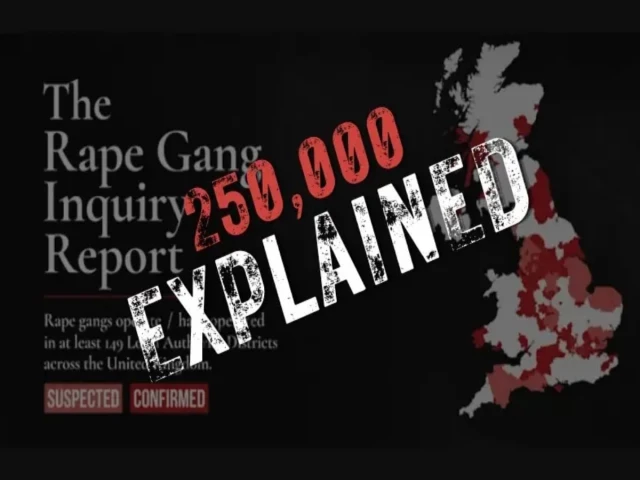
The claim came about after the publication of ‘The Rape Gang Inquiry Report’, shared publicly on June 16 by British politician Rupert Lowe in the UK parliament. The report and excerpts from it attracted substantial online engagement and were subsequently circulated by politicians, political commentators and influencers.
Even international media outlets such as FirstPost, News18, Visegrad24, Wave News Network, and others carried news articles based on the claim.
As the figure gained attention, questions emerged: where did it come from, who is it attributed to, is the number even accurate, and many more. Some also questioned whether the figure reflected documented national data.
What the 2026 inquiry report says
The iVerify Pakistan team conducted a detailed reading of the report and found that the figure of 250,000 used online was not presented as an official government estimate, police statistic or verified national victim count.
Page 12 of the report stated that the 250,000 figure was not based on government or law enforcement data; instead, it was based on remarks passed by Lord Malcolm Pearson during debates in the House of Lords over the years, as seen here and here.
The report later repeated that reasoning and argued that applying localised estimates and assumptions about underreporting could produce a national figure reaching 250,000. However, it did not provide a detailed statistical methodology showing how that estimate was calculated.
The report also acknowledged that the number was not intended as a precise count, stating that no comprehensive national total exists.
The local inquiry most frequently cited in relation to the estimate was the 2014 Independent Inquiry into Child Sexual Exploitation in Rotherham, led by Professor Alexis Jay. It described a conservative estimate that approximately 1,400 children had been sexually exploited in Rotherham between 1997 and 2013.
But researchers and fact-checkers examining the viral claim noted several limitations in extending those findings nationally. The Rotherham inquiry did not provide a gender-specific breakdown of victims, and applying results from one locality to the entire country assumes comparable reporting patterns, prevalence and conditions across different regions.
Subsequent national work also highlighted the limits of existing data.
The national Independent Inquiry into Child Sexual Abuse (IICSA), published in 2022 and chaired by Prof Jay, also concluded that it was not possible to determine the full scale of child sexual exploitation by organised networks at a national level. The inquiry noted that criminal justice records do not capture all such cases and that available datasets do not provide a complete picture.
It stated in its Prevalence section:
“Offence codes: Police data collection and reporting is generally driven by type of offence but there is no specific offence of child sexual exploitation. Instead, four criminal offences are listed under the heading ‘child sexual exploitation’ in the Sexual Offences Act 2003.[1] In 2018/19, offenders were charged with 1,012 offences within this group.[2] In 2019/20, the latest full year for which figures are available at the time of writing, this rose to 1,363.[3] However, these categories do not include more serious crimes such as rape, which may also involve child sexual exploitation.[4] For that reason, crime statistics for offences listed as child sexual exploitation fail to capture the most serious child sexual exploitation crimes.”
As a result, no official national dataset was identified that supports the figure of 250,000 victims. That absence of comprehensive national data has become part of the broader public argument itself.
Gap between claim and evidence
The real number of children sexually exploited by organised grooming gangs in the UK remains unknown, as admitted by the country’s own national inquiry.
While the 250,000 figure has travelled far and fast on social media, it doesn’t come from government data, law enforcement records or any verified national count. Instead, it traces back to extrapolations built on localised estimates, underreporting assumptions and public remarks.
This explainer was originally published by iVerify Pakistan — a project of CEJ-IBA and UNDP.