


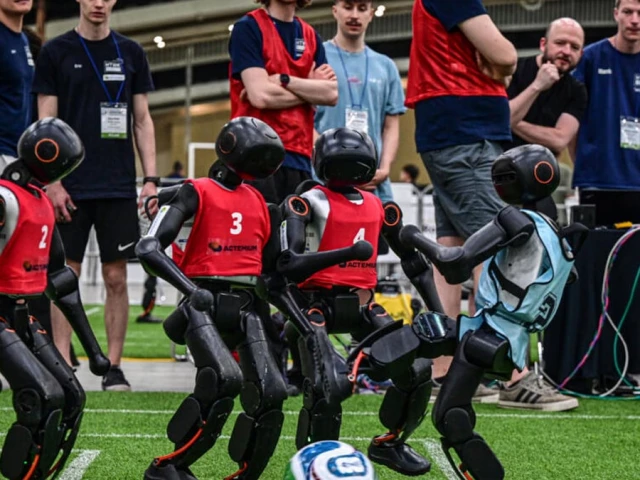
Robots take part in a football match at RoboCup 2026. Photo: AFP
LONDON:
Thirty seconds before kick-off, humanoid robot footballers in red and blue jerseys await the referee’s signal in the South Korean port city of Incheon.
The match setting is RoboCup, branded as the world’s largest robotics competition, where engineers are betting on a fully autonomous robot team that can one day defeat the FIFA World Cup champions.
Unlike remote-controlled machines, RoboCup’s robots make decisions on their own once a game begins, testing dramatic recent advances in artificial intelligence.
On the field Friday, a referee shouted “stop!” as a shot flew out of bounds — prompting every robot to freeze instantly.
Moments later, one squad member — named “number one” — scored, to cheers from dozens of spectators.
But then came a foul: one robot barges into the goalkeeper, sending it crashing to the ground.
“You can’t do that,” one spectator laughed.
Across Incheon’s Songdo Convensia convention centre, dozens of matches unfolded simultaneously on Friday as small, medium and large humanoid robots competed on compact pitches and spectators drifted from court to court.
Founded in Japan in 1997, RoboCup has expanded beyond football into rescue, home service and industrial robotics while pursuing its long-term goal of building a fully autonomous robot team capable of defeating the FIFA World Cup champions by 2050.
Although the robots play autonomously, human team members relay the referee’s commands — such as “stop” and “resume” — through software during matches, Lea Wedmann, of the Hamburg Bit-Bots team from Germany’s University of Hamburg, told AFP.
Visitors said watching robot football felt surprisingly similar to viewing a human sporting event.
“I had never seen robots playing football before. It was fascinating and really fun,” Cho Woo-cheol, a 45-year-old construction company worker, told AFP.
“When I first saw them, I found myself supporting the blue team because they looked a bit more human.
“They’re obviously not moving exactly like people yet, but they were much closer than I expected. Robot football has its own unique charm.”
The Messi robot
Another visitor, Kim Mi-hong, 60, predicted robot athletes could one day attract loyal supporters.
“If they become really good, I think they’ll have fans,” she told AFP.
“People were already saying, ‘The red team is better,’ and recognising players by their numbers. As the technology improves, I think fandoms will naturally emerge.”
That future may not be too far ahead.
“We think robots can defeat humans by 2050,” said Thomas Rofer, spokesperson for Germany’s B-Human team at the German Research Center for Artificial Intelligence.
“Recently there has been a big step forward in humanoid robot development. We have already seen one company here demonstrate a robot that can kick as hard as a human.”
Researchers say advances in artificial intelligence have dramatically accelerated progress in recent years.
Morgan Stanley Research estimates that by 2050 around 930 million humanoid robots will be working in repetitive, structured tasks, with the global humanoid robotics market potentially reaching $5 trillion.
Unlike professional football, RoboCup offers no prize money, with university teams competing primarily to advance robotics research.
But Shim In-wook, a professor of smart mobility engineering at Inha University, believes robot football will ultimately become a sport in its own right.
“In the FIFA World Cup you might have one Lionel Messi,” he told AFP.
“But once you build one Messi robot, you can build thousands more.”