Cairo meeting praises Pakistan’s mediation role, backs implementation of commitments under Islamabad MoU
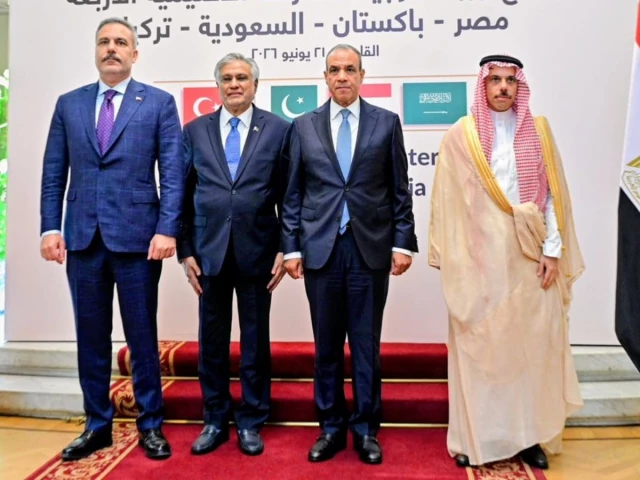
Foreign ministers of Turkiye, Pakistan, Egypt and Saudi Arabia pose for a group photograph after their meeting in Cairo on Sunday. Photo: X/ FO
Pakistan and the foreign ministers of Saudi Arabia, Egypt and Turkiye on Sunday reaffirmed the importance of continued consultation and coordination among the four countries in support of peace and stability, while welcoming the signing of the Islamabad Memorandum of Understanding (MoU) between the United States and Iran.
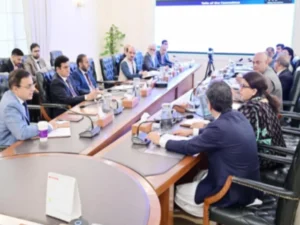
The R-4 Ministerial meeting was held in Cairo, where FM Ishaq Dar, Saudi Arabia’s Prince Faisal bin Farhan Al Saud, Turkiye’s Hakan Fidan and Egypt’s Dr Badr Abdelatty discussed regional and international developments.
According to a statement issued by the Foreign Office, the foreign ministers met in Cairo at the invitation of Egypt.
“The ministers expressed their deep appreciation to President Abdel Fattah El-Sisi for sharing his vision of the region’s future as a guidance to the group’s efforts aiming at bringing stability to the Middle East,” the statement said.
Read: US-Iran talks begin in Switzerland, says Qatar
It added that the meeting provided an opportunity for a comprehensive exchange of views on regional and international developments, while reaffirming the importance of continued consultation and coordination among the four countries to support peace, security, stability, and prosperity in the Middle East and the broader region.
The four ministers welcomed the signing of the Islamabad MoU between the United States and Iran earlier this week, describing it as a significant step towards reducing tensions in the region.
🔊PR No.1️⃣4️⃣9️⃣/2️⃣0️⃣2️⃣6️⃣
Joint Statement: Fourth Consultative Meeting of the Foreign Ministers of the Arab Republic of Egypt, the Islamic Republic of Pakistan,the Kingdom of Saudi Arabia and the Republic of Turkiye, Cairo Arab Republic of Egypt – June 21,2026
🔗⬇️ pic.twitter.com/k5v4W6CzGN
— Ministry of Foreign Affairs – Pakistan (@ForeignOfficePk) June 21, 2026
“The minister viewed this important development as a constructive step towards de-escalation and towards ending a conflict which posed significant risks to regional security and stability, as well as to energy markets, international maritime routes, global supply chains, and international trade,” it said.
They also commended the efforts of regional and international actors that helped facilitate the understanding and stressed the importance of implementing the commitments undertaken by the parties concerned.
The R-4 Ministerial meeting commenced in Cairo, Egypt, in a restricted format where the Foreign Ministers of Pakistan @MIshaqDar59, Egypt @MFAEgypt, Saudi Arabia @FaisalbinFarhan, and Türkiye @HakanFidan, discussed regional developments, implementation of the Islamabad MoU, and… pic.twitter.com/z4Jw71hYYr
— Ministry of Foreign Affairs – Pakistan (@ForeignOfficePk) June 21, 2026
“The ministers emphasised the importance of the faithful implementation of the commitments undertaken by the parties concerned,” the statement said.
The foreign ministers of Turkiye, Egypt and Saudi Arabia also praised Pakistan’s role in helping secure the agreement and acknowledged Qatar’s support during the negotiations.
Deputy Prime Minister / Foreign Minister Senator Mohammad Ishaq Dar @MIshaqDar50 participated in the 4th Meeting of the Regional Four (R-4) Foreign Ministers (of Pakistan, Saudi Arabia, Türkiye, Egypt) in Cairo, Egypt today.
The Ministers reviewed progress on the Islamabad MoU,… pic.twitter.com/PL9nKLz6US
— Ministry of Foreign Affairs – Pakistan (@ForeignOfficePk) June 21, 2026
“The ministers lauded the instrumental efforts of the Islamic Republic of Pakistan in reaching this historic outcome, along with the support extended by the State of Qatar to bring about a successful conclusion to the negotiations on the MoU,” the statement said.
They also appreciated Pakistan’s close coordination with the three countries throughout the process.
Building on the momentum generated by the agreement, the ministers underscored the need for the swift and successful completion of the next phase of negotiations aimed at resolving remaining issues through a lasting, verifiable and mutually acceptable arrangement.
“The ministers stressed that the positive momentum created by the MoU should be sustained through continued dialogue and negotiations,” the statement said.
The meeting also highlighted the importance of addressing the concerns of countries in the region, particularly regarding the security and stability of the Gulf Arab states and the Levant.
“The ministers emphasised that regional security considerations must remain central to efforts aimed at strengthening collective security and promoting long-term stability,” the statement added.
Reaffirming the centrality of the Palestinian issue to peace and stability in the Middle East, the ministers said the Palestinian cause remained at the heart of efforts to achieve a just, comprehensive and lasting peace in the region.
Particular attention was devoted to the humanitarian and political situation in Gaza, the West Bank and occupied East Jerusalem.
The ministers reiterated their support for the legitimate rights of the Palestinian people, including their right to self-determination and the establishment of an independent Palestinian state based on the June 4, 1967 borders, with East Jerusalem as its capital.
“The ministers reaffirmed that the establishment of an independent Palestinian State remains an indispensable foundation for achieving a just, comprehensive and lasting peace in the region in accordance with relevant United Nations Security Council resolutions,” the statement said.
Dar says US-Iran talks have advanced greatly
Meanwhile, FM Dar said that issues between the US and Iran have advanced “greatly”.
In an interview with Al Arabiya during his visit to Cairo, Dar expressed “trust” that both sides would ultimately reach a final agreement.
He added that the next phase of negotiations between Washington and Tehran would be “more difficult”.
Dar said that it was agreed to reduce the enrichment level of Iran’s nuclear stockpile and that the two sides reached a conclusion that diplomacy was the solution.
He also said no transit fees would be imposed in the Strait of Hormuz during the 60 days, adding that there would be no charges for either “transit” or “services”.
Dar further said that three technical teams are currently in Switzerland to discuss the nuclear issue, frozen Iranian assets and the situation in Lebanon.
US and Iranian delegations are in Switzerland for talks, following the signing of a memorandum of understanding on Wednesday to end months of conflict in the Middle East and reopen the Strait of Hormuz.
The talks in Burgenstock are led by US Vice President JD Vance, and Parliament Speaker Mohammad Bagher Ghalibaf and Foreign Minister Abbas Araghchi on the Iranian side, under Pakistani mediation.