Joint border markets, Gwadar port cooperation on agenda as neighbours revive economic ties
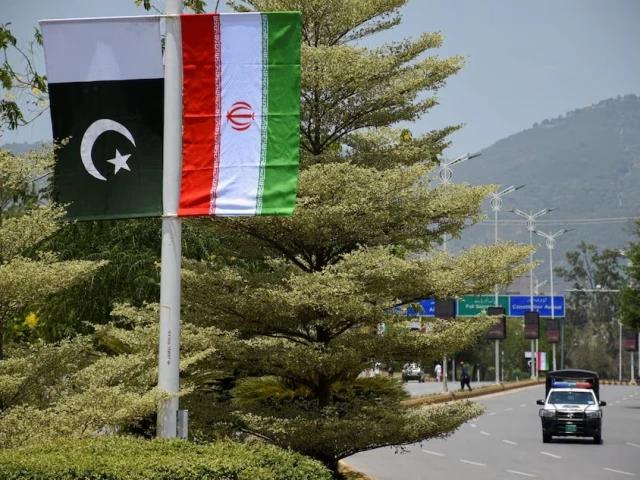
Iranian and Pakistani national flags are displayed along a street ahead of the arrival of Iran’s President Masoud Pezeshkian in Islamabad, Pakistan, June 23, 2026— REUTERS
ISLAMABAD/KARACHI:
Pakistan and Iran have agreed to increase bilateral trade to $10 billion and expedite the finalisation of a free trade agreement (FTA), as the two neighbouring countries moved to deepen commercial ties during the 10th session of the Pakistan-Iran Joint Trade Committee in Islamabad.
The session was co-chaired by Commerce Minister Jam Kamal Khan and his Iranian counterpart Mohammad Atabak, who reaffirmed their commitment to raising bilateral trade volumes. Jam Kamal said transforming Pakistan-Iran relations into a strong economic partnership was essential. He emphasised the early finalisation of the FTA and stressed the need to remove bottlenecks in border logistics, customs procedures and cargo movement. He added that bilateral trade could be enhanced through joint border markets and electronic data interchange systems.
Atabak described Pakistan as Iran’s long-term strategic trade partner and expressed a desire to expand regional trade and logistical cooperation through the ports of Karachi and Gwadar. He voiced optimism that the FTA would be concluded soon, adding that electricity trade and regional connectivity could create new economic opportunities.
Pakistan and Iran enjoyed robust trade relations before sanctions on Tehran intensified more than a decade ago, with bilateral trade surpassing $1.2 billion in FY10. However, tightening restrictions, including banking and financial sanctions, severely curtailed formal trade flows. Both countries could revive trade supported by greater economic engagement and the planned development of border Special Economic Zones, according to a report by Topline Securities.
Before sanctions disrupted trade, Pakistan exported rice, meat, paper, textiles, fruits and surgical goods to Iran, while importing chemicals, plastics, oil, iron and steel products. The Iran-Pakistan gas pipeline, which would deliver up to 750 million cubic feet of natural gas per day, could address Pakistan’s chronic energy deficit and drive industrial growth, KTrade analysts said. However, Topline cautioned that the long-delayed pipeline is unlikely to see immediate progress. Any revival would require not only the easing of sanctions but also a renegotiation of pricing and contractual terms to make it commercially viable for Pakistan.
Jam Kamal stressed the need to finalise practical roadmaps to elevate the economic partnership to a new level, noting that the private sectors of both countries were ready to expand trade.