
Iranian president holds talks with President, PM, COAS, Pezeshkian praises Pakistan’s sincere mediation
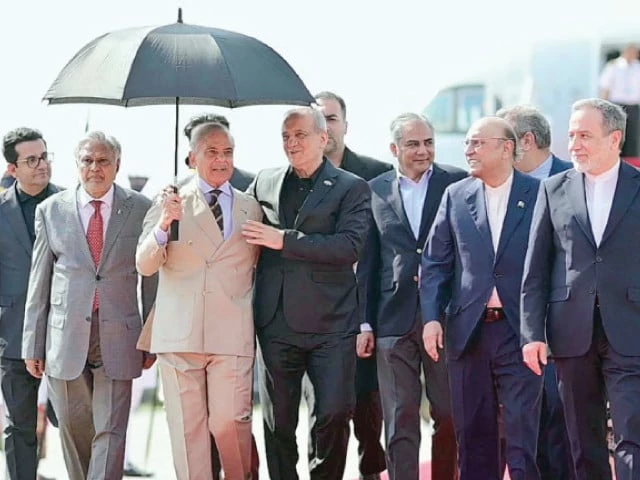
Prime Minister Sharif holds an umbrella over visiting Iranian President Dr Masoud Pezeshkian as he and President Asif Ali Zardari extend a cordial welcome upon his arrival at Nur Khan Airbase. Photo: PPI
ISLAMABAD:
Iranian President Masoud Pezeshkian on Tuesday acknowledged Pakistan’s pivotal mediation role in recent diplomatic efforts between Tehran and Washington, saying Islamabad’s intervention was instrumental in reaching the current stage of negotiations, as both Iranian and Pakistani leaders firmly rejected reports that Iran’s ballistic missile programme was part of any discussions.
Pezeshkian arrived in Islamabad on his first foreign visit since the recent war, receiving a red-carpet welcome at Nur Khan Airbase. His aircraft was escorted by Pakistan Air Force fighter jets upon entering the Pakistani airspace, while a 21-gun salute marked his arrival, honours reserved for distinguished state guests and close allies.
Accompanied by a high-level delegation, including Foreign Minister Abbas Araghchi, the Iranian president was received by President Asif Ali Zardari and Prime Minister Shehbaz Sharif.
Speaking at a joint press conference with Prime Minister Shehbaz after delegation-level talks, Pezeshkian thanked Pakistan’s leadership and people for their support during a difficult period and praised Islamabad’s efforts to facilitate dialogue and de-escalation.
“At a critical historical juncture that the region is facing multiple challenges, the responsible and visionary role played by Pakistan in supporting discussions and negotiations aimed at de-escalation and strengthening regional stability reflects a brotherly and forward-looking approach,” he said.
Lauding Pakistan’s mediation efforts, the Iranian president said Islamabad had remained sincere and steadfast throughout the process. “If it was not for the efforts made by your excellency and your team, we would not have been here today,” Pezeshkian remarked, directly acknowledging Prime Minister Shehbaz’s role.
The Iranian president also described Pakistan as more than a neighbour, saying the two countries were bound by deep historical, cultural and religious ties and shared a common destiny. However, the strongest message from the joint appearance concerned Iran’s ballistic missile programme, following speculation that the issue had figured in discussions between Tehran and Washington.
Prime Minister Shehbaz categorically dismissed such reports. “Let me say without any fear of contradiction that ballistic missiles were never a subject of discussion between Iran and the United States. It was not on the table at all and there is no mention of ballistic missiles anywhere in the MoU,” he said.
Pezeshkian echoed the same position, describing Iran’s missile capability as a non-negotiable element of its national defence. “I would like to confirm that our missile programme was not included in the MoU and shall not be included in the MoU,” he said.
“If it were not for Iran’s missile capabilities, our country would have been plundered and destroyed by the US regime and the Zionist regime. We shall never compromise on our missile capabilities and this shall never be part of any agreement between Iran and any other party.”
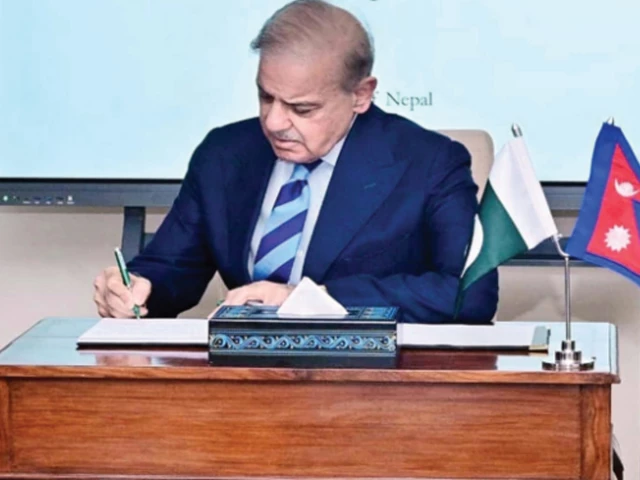
Prime Minister Shehbaz welcomed the signing of the Islamabad Memorandum of Understanding and expressed the hope that the ongoing technical-level talks would eventually culminate in a comprehensive agreement.
According to the Prime Minister’s Office, Shehbaz said he expected the Islamabad MoU to “evolve into a formal agreement and open new avenues of development.” He also warned that there were forces unhappy with the progress achieved through the peace initiative.
“There is no shortage of elements in the world that are unhappy with the gains made through the Islamabad Memorandum of Understanding. Pakistan and Iran will stand like an iron wall against those seeking to sabotage peace in the region,” he said.
The prime minister reiterated Pakistan’s solidarity with Iran, saying, “Your happiness is our happiness and your sorrow is our sorrow.”
Earlier, during delegation-level talks at the Prime Minister’s House, Shehbaz thanked the Iranian leadership for trusting Pakistan with a mediation role and pledged continued support for peace efforts. “As brothers, we will never let you down,” he told the visiting Iranian delegation.
The prime minister also credited Field Marshal Syed Asim Munir for playing an important role in efforts that eventually led to the ceasefire and the signing of the Islamabad MoU, saying the army chief had worked tirelessly during the crisis to prevent a wider regional conflict.
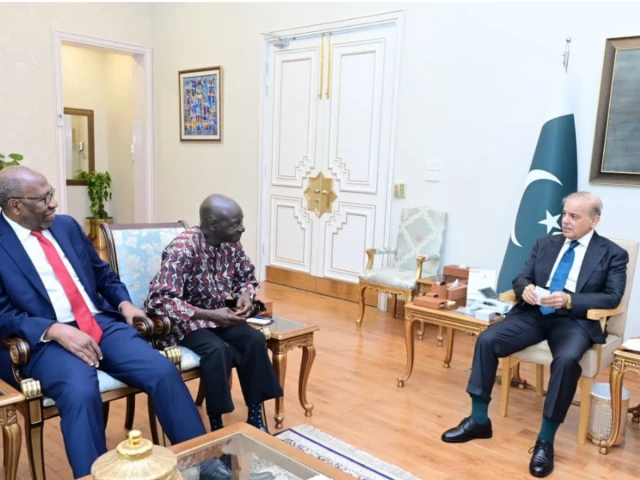
Separately, President Pezeshkian met President Asif Ali Zardari at Aiwan-e-Sadr, where the two leaders discussed bilateral ties, regional peace and security, economic cooperation and connectivity initiatives.
President Zardari congratulated the Iranian president on the signing of the Islamabad MoU and expressed the hope that the ongoing technical negotiations would lead to a durable and lasting peace. He reaffirmed Pakistan’s support for Iran’s sovereignty, territorial integrity and stability, while stressing the importance of dialogue and diplomacy in resolving regional disputes.
Pezeshkian thanked Pakistan for its constructive role in promoting peace and dialogue and said that Tehran attached great importance to its relationship with Islamabad.
The Iranian president also met Chief of Army Staff and Chief of Defence Forces Field Marshal Syed Asim Munir. According to the ISPR, discussions focused on regional developments and ongoing peace initiatives.
During the meeting, Pezeshkian appreciated Pakistan’s “constructive and responsible role” in promoting dialogue, de-escalation and regional stability, and acknowledged Islamabad’s consistent efforts to encourage peaceful resolution of disputes amid heightened geopolitical tensions.
Field Marshal Asim Munir reaffirmed Pakistan’s commitment to regional peace and stability, while both sides agreed to maintain close consultations on issues of mutual interest and further strengthen Pakistan-Iran relations.
The visit underscored the growing diplomatic engagement between Islamabad and Tehran in the aftermath of the conflict, with both sides expressing optimism that the Islamabad MoU would pave the way for lasting peace, enhanced regional cooperation and stronger bilateral ties.