


The message centres on piety, oneness of God, patience, gratitude, and abandoning sins
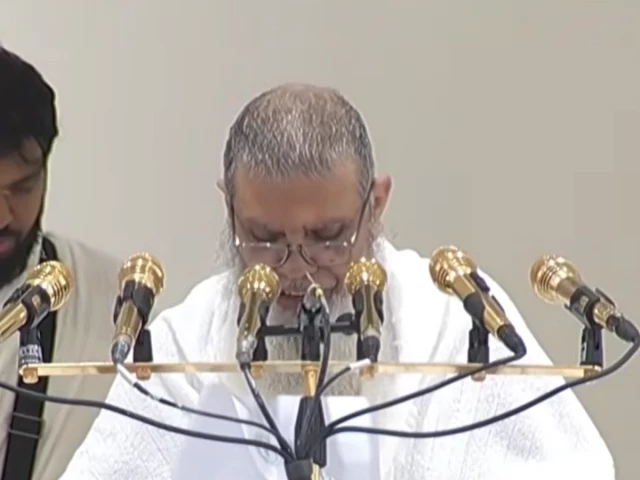
Sheikh Ali Al-Hudhaify delivering the 2026 Hajj sermon at Masjid Namirah in the plains of Arafat. SCREENGRAB
Sheikh Ali Al-Hudhaify, the Imam and Khateeb of Al-Masjid an-Nabawi in Madina, delivered the 2026 Hajj sermon at Masjid al-Namirah in the plains of Arafat on Tuesday, addressing pilgrims with a message centred on piety (taqwa), oneness of God (Tawheed), preparation for the Day of Judgment, unity among Muslims, and the spiritual significance of Hajj.
The sermon took place at Masjid Namirah in Arafat, where over 1.5 million pilgrims from across the globe gathered to perform Waqoof-e-Arafah, the central rite of Hajj. The Day of Arafat is considered the holiest day in the Islamic calendar, a time when believers seek divine forgiveness and draw spiritually closer to God.
Beginning the sermon with praise for Allah and salutations upon the Holy Prophet Muhammad (peace be upon him), Sheikh Al-Hudhaify reminded worshippers that Hajj was one of the pillars of Islam and urged believers to strengthen their faith through obedience to Allah and sincere worship.
“Observe Taqwa of Allah, for therein lies the salvation of the servant in his Hereafter,” he said, while reciting verses from Surah Al-Hajj describing the horrors of the Day of Judgment, when “every nursing mother will be distracted from what she was nursing” and “every pregnant woman will drop her load.”
The imam stressed that preparation for the Hereafter came through righteous deeds, patience, gratitude, and abandoning sins, while emphasising that the foundation of Islam was Tawheed — worshipping Allah alone without associating partners with Him.
The sermon repeatedly highlighted the oneness of Allah and the importance of sincerity in worship, prayer, charity, fasting, and pilgrimage. The imam also reminded pilgrims that Hajj was proclaimed by Prophet Ibrahim and remained a sacred act of worship, bringing together Muslims from every race, language, and nation.
Read: Haj pilgrim numbers surpass 2025 arrivals despite Middle East war
“The pilgrims come from every distant land, responding to the call of Tawheed, seeking the pleasure of Allah and His reward,” he stated.
Addressing conduct during Hajj, Sheikh Al-Hudhaify urged pilgrims to avoid disputes, crowding, pushing, political slogans, and divisive behaviour, stressing that Hajj was a place of humility, remembrance of Allah, and unity.
“There is no wrongdoing in Hajj, no disputing, no political slogans or partisan calls, but rather submission to Allah,” he said.
The imam also highlighted the importance of following regulations and instructions issued by organising authorities to protect lives and facilitate the smooth performance of rituals, particularly during movements between Arafat, Muzdalifah, and Mina and while performing the stoning of the Jamarat.
Throughout the sermon, Sheikh Al-Hudhaify referenced numerous Quranic surahs related to Hajj, patience, remembrance of Allah, and accountability in the hereafter. He also reflected on the rites performed by the Holy Prophet Muhammad (peace be upon him) during his farewell pilgrimage, including standing at Arafat, proceeding to Muzdalifah, sacrificing animals, stoning the Jamarat, and performing Tawaf.
The sermon further stressed the unity and brotherhood displayed during Hajj, describing pilgrims as people gathered in mutual support and harmony despite differences in language, colour, and nationality.
Special prayers were offered for the acceptance of the pilgrims’ worship, forgiveness of sins, safety and ease in completing Hajj rituals, and the well-being and unity of Muslims across the world.
The imam also prayed for the Custodian of the Two Holy Mosques, Salman bin Abdulaziz Al Saud, and Crown Prince Mohammed bin Salman, acknowledging their efforts in facilitating Hajj services and caring for the two holy mosques and pilgrims.
Following the sermon, pilgrims began their journey to Muzdalifah, situated between Arafat and Mina, where they will spend the night collecting pebbles for the symbolic stoning of the devil—scheduled for Wednesday, as the Hajj continues.