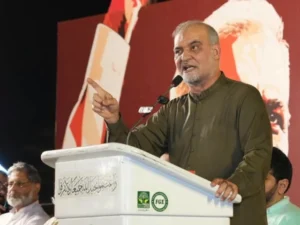
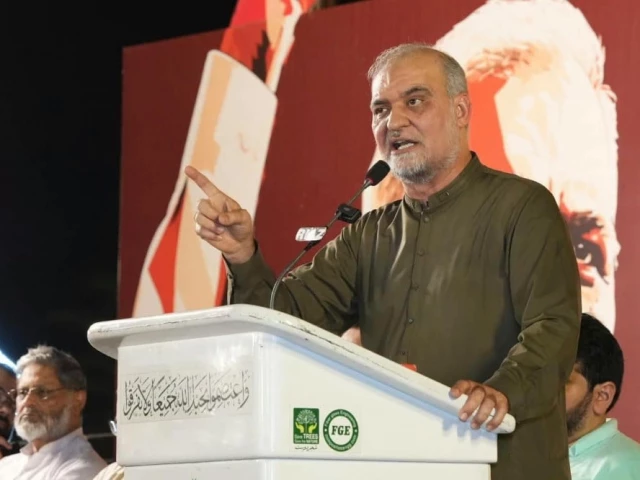
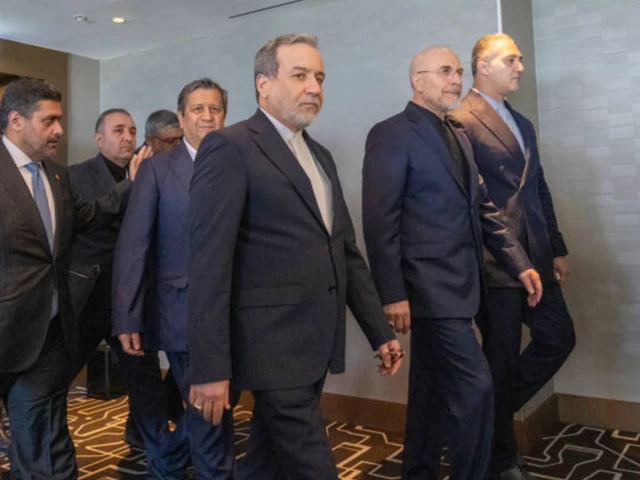
Iranian Foreign Minister Abbas Araghchi and Parliament Speaker Mohammad Bagher Ghalibaf in Switzerland. Photo: AFP
Iran said on Wednesday that the US bears international responsibility for damages caused by its unilateral sanctions and must provide full compensation, including restitution and reparations.
In a message to the UN and Security Council, Foreign Minister Abbas Araghchi described the US measures as an “economic terrorism campaign” carried out through unilateral coercive measures, which he said are unlawful under international law.
“The Islamic Republic of Iran reserves its right to resort to all available means to pursue accountability, compensation and redress, and to hold the perpetrators of these inhumane and unlawful acts accountable,” Araghchi said, according to Iran’s state broadcaster IRIB.
He said the US campaign “entails international responsibility, including an obligation to provide full compensation for all material and moral damages, including restitution and reparations, in accordance with international law.”
Araghchi also said the US bears “full international responsibility” and can face individual criminal responsibility, if the relevant legal elements are established, for the consequences of “unlawful and criminal acts and the harm caused to the Iranian people.”
He urged the UN Security Council and member states to condemn and reject Washington’s use of “unilateral coercive measures and secondary sanctions” to pressure sovereign states into changing their legitimate economic interests and trade relations.
Iran also called on countries not to recognise, approve or implement such measures that seek to link their sovereign rights to policies unilaterally determined by Washington.
Araghchi urged the US “to immediately halt threats and coercive actions aimed at forcing third countries and their nationals to alter legitimate economic relations and interests.”
He also called on the UN Secretary-General Antonio Guterres to assess and report on the humanitarian and human rights consequences of such measures, including their impact on civilians’ access to food, medicine, health care, energy, transportation and humanitarian assistance.
Araghchi said relevant evidence should be independently assessed, documented and preserved to ensure future accountability.
Iran says US sanctions will achieve nothing
Iran’s president has insisted that the United States would achieve nothing with its new sanctions campaign after Washington laid out plans to collapse the country’s economy, AFP reported on Thursday.
“America will not achieve anything with economic pressure at this stage, just as it was unable to achieve anything in the war,” Iranian President Masoud Pezeshkian said, according to the country’s ISNA news agency.
“We will stand firm against economic pressures, as we have done so far and will continue to do.”
Qatar PM to visit Tehran to pursue mediation efforts
Qatar’s prime minister will visit Tehran on Thursday in a bid to relaunch diplomacy after the US and Iran traded recriminations over Washington’s promise to increase economic pressure on Tehran by targeting its trade partners for sanctions.
A Gulf neighbour of Iran and a US ally, Qatar has served as a back-channel negotiator for the warring parties and played a direct role in securing the June ceasefire that briefly led to a cessation of hostilities.
The visit comes as the war nears its sixth month with fighting largely paused but no diplomatic breakthrough in sight. Both sides are at odds over control of the Strait of Hormuz, a chokepoint for global oil supplies that Tehran has used as leverage.
An unidentified projectile hit a tanker in the strait to set off a fire that was later doused, the United Kingdom Maritime Trade Operations agency said early on Thursday, but all crew were safe and accounted for.
The memorandum of understanding broke down in part because of differences over the narrow waterway between Iran and Oman where one-fifth of the world’s oil supplies passed before the war began on February 28.
Read: Iran and Oman still working on Strait of Hormuz accord, says senior Iranian source
The guns have gone mostly silent — the US military’s Central Command has not reported any attacks on Iran for nearly a month. Washington appears to be leaning more on economic pressure by announcing plans to cut Iran off from its trading partners with increased sanctions.
Hormuz oil flows have fallen to a three-month low, with just 5 million barrels per day transiting on Monday, according to the latest ship-tracking data. Before the war, the strait carried roughly 20 million barrels per day of crude oil.
Iran’s Revolutionary Guards said on Wednesday that Iran and Oman had agreed how to share the waterway and its revenues, but a senior Iranian source later said the two countries were still working on the details of an agreement.
Despite an aerial bombardment earlier in the war that severely diminished Iran’s conventional forces, Tehran has maintained enough missile and drone capability to attack Gulf neighbours that house US military bases and disrupt oil tankers in the strait.
The UN’s International Maritime Organisation has reported 70 incidents in the Strait of Hormuz since February 28 that have killed 19 seafarers.
Thousands of others have died, mostly in Iran and Lebanon, since the US and Israel attacked Iran with the stated goals of denying Iran a nuclear weapon, helping Iranians topple their government, and destroying Iran’s missile programme.
Mediator
Qatari Prime Minister Sheikh Mohammed bin Abdulrahman al-Thani will discuss the continuation of Qatar’s mediation efforts and other developments in the region during his visit to Tehran on Thursday, Iranian Foreign Ministry spokesperson Esmaeil Baghaei said.
Qatar’s Foreign Ministry spokesperson said on X that Sheikh Mohammed would also address freedom of navigation in the Strait of Hormuz and the need to return to the status quo before February 28, while also discussing with Iranian officials ways to “de-escalate tensions and create the conditions conducive to dialogue.”
Read more: CDF presses for end to US-Iran stalemate
The international waterway was open to free navigation before the war, but Iran has since clung to its control of the strait as leverage and a revenue source, seeking to charge ships a commission, which the US has opposed.
“An agreement with Oman over the Strait of Hormuz has not been finalised,” the senior Iranian source told Reuters, adding that the talks were continuing on the details of an accord.
That seemed to contradict a statement by Brigadier General Hossein Mohebbi, a spokesperson for the Islamic Revolutionary Guard Corps, who said Iran and Oman had “reached results that are acceptable to both sides” on controlling the strait and its revenues.
Mohebbi said the strait would remain shut unless the US met Tehran’s conditions under the interim ceasefire, or memorandum of understanding, that the two sides signed in June before it unravelled. Those conditions include an end to the US blockade on Iranian ports, compensation and removal of sanctions.
Iran and Oman have held on-and-off talks for weeks about controlling traffic through the strait. Tehran and Washington have each tried to assert control over the channel, imposing separate blockades.