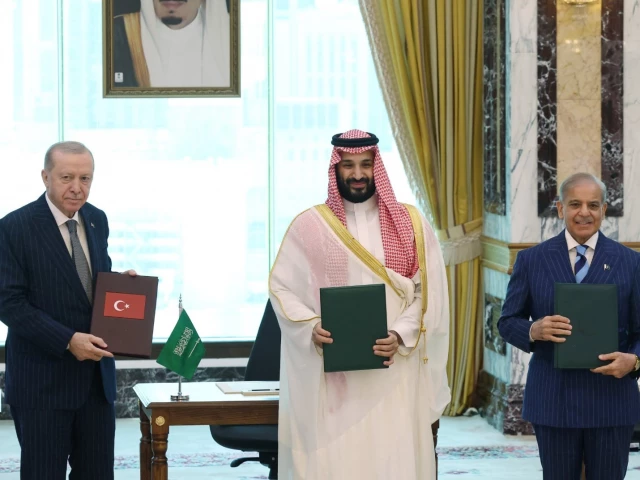
Shows how Middle East ‘coming together’ to defend itself in a ‘more meaningful way’, says US president
Turkish President Tayyip Erdogan, Saudi Crown Prince Mohammed bin Salman and Prime Minister Shehbaz Sharif pose after signing a joint defence agreement in Makkah, Saudi Arabia on August 7, 2026. PHOTO: REUTERS
US President Donald Trump on Monday welcomed the signing of the Makkah Joint Defence Agreement by Turkiye, Pakistan and Saudi Arabia.
“Very happy to see that Saudi Arabia, Turkiye and Pakistan have recently, and finally, signed the Makkah Joint Defence Agreement,” he said on Sunday on Truth Social.
Trump said the deal shows “how the Middle East is coming together, and how countries will finally be able to defend themselves in a more meaningful way. Congratulations to the Great Leadership of the three nations mentioned.
“THIS IS A BIG, BOLD, AND IMPORTANT FIRST STEP — WOW!” he added.
Read: PM Shehbaz appreciates Trump’s support for Makkah defence pact
On August 7, Pakistan, Saudi Arabia and Turkiye formalised their longstanding strategic relationship through the newly signed “Makkah Joint Defence Agreement”, a trilateral security framework that its proponents describe as a defensive arrangement aimed at strengthening collective deterrence, enhancing military cooperation and promoting regional stability.
The agreement, signed during the Makkah Al-Mukarramah Summit for Joint Defence, has prompted comparisons with military alliances such as NATO. However, according to security analysts, the pact is intended to formalise decades of existing strategic cooperation rather than create a new military bloc or offensive alliance.
According to security analysts, the agreement represents the natural progression of longstanding political, military and strategic relations among the three countries.
Rather than establishing an entirely new partnership, analysts say the agreement provides a formal institutional framework for cooperation that has evolved over many years.
Security analysts say that the agreement reflects a rapidly changing regional security environment, pointing to regional conflicts, evolving security threats and changes in the character of modern warfare as factors driving closer strategic coordination among countries that share common security interests.
According to them, the trilateral framework is intended to preserve regional stability by strengthening collective security mechanisms instead of relying on ad hoc bilateral cooperation.
The agreement establishes a framework based on the principles of collective security and collective deterrence. Analysts say its central premise is that aggression against one member would be regarded as a threat to all three, thereby increasing the potential cost of military action and discouraging conflict through credible deterrence.
The framework also envisages expanded defence cooperation, including closer military coordination, intelligence sharing, strategic consultations, defence planning and broader institutional cooperation between the three countries.
According to analysts, pooling military capabilities and strategic coordination is intended to improve preparedness while reducing the likelihood of regional conflict.
They add that Pakistan contributes experienced armed forces, operational expertise and strategic planning capabilities developed through decades of counterterrorism operations and conventional military preparedness, while Saudi Arabia brings economic strength, regional influence and political leadership, and Turkiye contributes an advanced defence industry, military technology and industrial capacity.
Makkah defence agreement sends ‘important message’ to the world: Turkish president
Turkish President Recep Tayyip Erdogan said the Makkah Joint Defence Agreement represented a different kind of transformation, stressing that it presented “a real opportunity for us to deliver an important message to the world.”
Speaking in an interview with Al Jazeera Arabic television, recorded on August 14, the day the ruling Justice and Development (AK) Party celebrated its 25th anniversary, Erdogan said: “Coming together on such a day is truly a special joy for us.”
“With our 25th anniversary celebrations, we will, God willing, continue our journey toward many more quarter-centuries,” he said.
About the defence agreement, Erdogan said: “First of all, the Makkah agreement represented a different kind of transformation.”
“The signing of this trilateral agreement in Makkah between Saudi Arabia, Turkiye and Pakistan became an opportunity for us to deliver an important message to the world,” he said. “The fact that this agreement was concluded in Makkah and that we achieved it as three countries gave us additional strength and conveyed a separate message to the world.”
“I believe that Pakistan, Turkiye and Saudi Arabia all concluded this agreement with great satisfaction. May it be beneficial,” he said.
Stressing that the pact was signed during a difficult period between the US and Iran, Erdogan said it conveyed an important message for world peace.
Read more: Iran cannot have a nuclear weapon ‘in any way, shape, or form’: Trump
“I call it an important message for world peace because Turkiye is a country that stands for peace, and the choice of Makkah has been an important step for peace,” he said.
“During the process between Iran and the US, we consistently emphasised that we support peace,” Erdogan said. “As countries pursuing such a process in favour of peace, Pakistan, Turkiye and Saudi Arabia have taken their place as advocates of peace.”
“As defenders of peace, we will continue on this path as countries pursuing peace in the coming period,” he stressed.
Collective defence provision
Asked whether the Makkah agreement resembles NATO’s Article 5 collective defence provision, Erdogan said: “Whatever NATO’s Article 5 includes, similarly, this common defence understanding means that if any problem arises, these three countries will have the opportunity to take the necessary steps together.”
“Beyond these three countries, others may join us at any time,” he said. “It is not limited to Saudi Arabia, Turkiye and Pakistan.”
“Additional countries may also become part of it. When we signed the agreement, we announced that if other countries wished to join in the future, our door would remain open. We have kept that door open.”
“If Egypt wishes, these three countries can reach an agreement and open the door to Egypt as well,” the Turkish president added.