
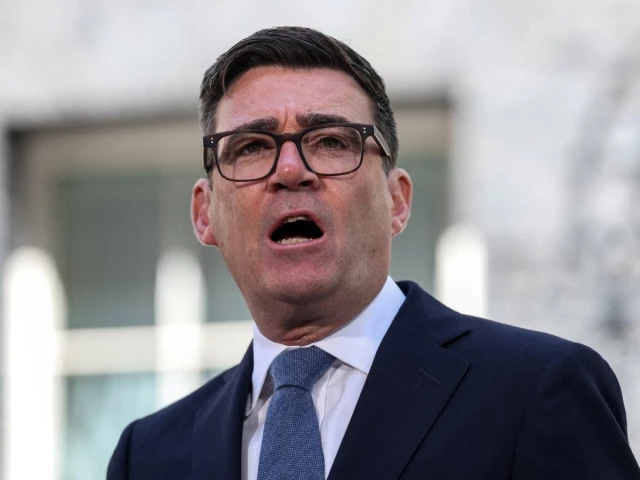
British PM Andy Burnham delivering his maiden address on July 20, 2026 at Downing Street, UK. Photo: AlJazeera
“I have accepted to form a government,” Andy Burnham, the UK’s seventh prime minister in a decade, begins his Downing Street speech, AlJazeera reported on Monday.
Andy Burnham had left Buckingham Palace, after being invited to form a government by the king, for his maiden speech as the British prime minister at Downing Street number 10.
The new UK prime minister has pledged to put the care of the people at the heart of the government. He also promised to build more council homes.
The new leader said he would set out a ten-year plan later this year and measures to help with the cost of living and give people “breathing space” tomorrow.
He said the first instruction he will issue on entering No 10 is “to end rough sleeping in our country”.
Burnham said this is “a moment for reflection and new resolution” and Britain must “regain our stability once again”.
“We have not been good enough,” he said.
The new party will introduce a new political model and a new economic model, he said.
Burnham’s guests – at least 100 of them – have gathered in Downing Street for his maiden speech.
British king ‘graciously pleased to accept’ Starmer’s resignation, Buckingham Palace says
Buckingham Palace has issued a statement confirming that Starmer has formally resigned, AlJazeera reported.
“Sir Keir Starmer MP had an audience of The King this morning and tendered his resignation as Prime Minister and First Lord of the Treasury, which His Majesty was graciously pleased to accept,” it said.
“Lady Starmer was also received by The King.”
Andy Burnham set to take over as Britain’s prime minister, promising stable politics
Andy Burnham becomes Britain’s seventh prime minister in a decade on Monday, promising to “rewire” the nation to focus more clearly on issues people care about, such as a cost-of-living crisis and poorly performing services, Reuters reported on Monday.
After Keir Starmer made his farewell speech outside 10 Downing Street and formally tendered his resignation to King Charles, the monarch will receive Burnham to ask him to be prime minister.
Then the hard work begins for the 56-year-old who, as mayor of Greater Manchester, earned the nickname ‘King of the North’.
Read: The challenges facing UK’s next PM Andy Burnham
Once he has unveiled his cabinet – already the subject of much debate in the ruling Labour Party – he will have a long list of problems ranging from underperforming utility firms to anaemic economic growth.
Burnham to lay out new government path
Burnham will use his first speech to set out a path for “a more stable and responsible politics”, his office said in a statement.
Presenting his appointment as a moment of “reflection”, he will say it is time to be honest about Britain’s challenges, and that only political stability can deliver improvements.
On Friday, Burnham described his election to become Labour leader as “the most significant change moment in our politics for 40 years”.
He promised to radically change the political system to quickly raise living standards and help a country hungry for change become one where “life is more affordable, and all people and places are lifted from where they are now”.
He directed that message at Labour lawmakers, who see him as one of the few politicians capable of tackling the threat from veteran Brexit campaigner Nigel Farage’s populist Reform UK – something they doubted the unpopular Starmer could do.
Burnham’s first challenge will be the appointment of his cabinet team, and especially his finance minister. Friction in this crucial partnership at the heart of government has led to the downfall of previous administrations.
An early frontrunner for the position, energy security and net zero minister Ed Miliband, has been the object of some hostile briefing and interior minister Shabana Mahmood now appears to be the favourite for the job.
Burnham urged his party on Friday to ignore “speculation” and said he had not yet decided on his team.
His early policy decisions will also face scrutiny.
Read more: What is new Labour leader Andy Burnham’s policy approach for Britain?
On Sunday, plans were scrapped for all employees to be required to hold a digital identity document, a scheme designed to tackle illegal migration but deemed a “fiasco” by a cross-party committee of lawmakers.
More attention will be paid to decisions on taxation and spending, oil and gas, and underperforming utility companies, for which Burnham wants stronger public control.
Thames Water, Britain’s largest water company, is weighed down by debt and under fire for frequent sewage leaks.
On Sunday, Deputy Labour Leader Lucy Powell, Burnham’s ally, suggested Thames Water could be brought under “special measures”, meaning it would operate under government control.
“He wants to refocus and reprioritise the government’s resources, the government’s attention onto his priorities of tackling the cost of living, really rewiring the way the country, the economy works,” she told Sky News.