


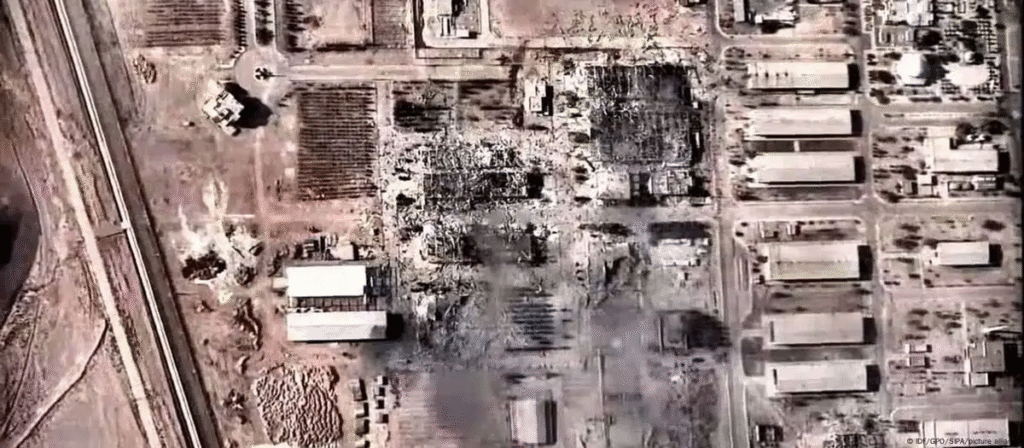
Recent Israeli and US attacks on Iran’s nuclear and military facilities could cause long-term environmental damage, including soil contamination.
It is not yet known how many missiles and bombs were fired at Iranian nuclear and military facilities during 12 days of war.
On June 22, the US attacked the Fordo, Isfahan and Natanz nuclear sites with 14 “bunker busting” bombs weighing 30,000 pounds (13,600 kilograms) each, along with 30 Tomahawk missiles.
According to Gaukhar Mukhatzhanova from the Vienna Center for Disarmament and Non-Proliferation, the actual extent of the damage is still unclear.
On June 23, she told DW that the UN’s International Atomic Energy Commission (IAEA) has not yet been able to fully verify the effects of the attacks, particularly on the underground enrichment plant at Fordo.
“We can see some damage on satellite images, but we don’t know the actual extent and cost.”
The IAEA assumes that there is radioactive and chemical contamination at several sites.
Thousands of centrifuges could have been damaged by the sudden power outages. The centrifuges work with the highly reactive uranium hexafluoride (UF6).
Although no increased radiation levels have yet been measured outside the plants, a possible leakage of these substances poses considerable health and environmental risks. IAEA inspectors currently have no access to the affected nuclear facilities.
Potential long-term environmental risks
“There is a lot we don’t know, and that is really the big problem,” said Roozbeh Eskandari, an independent environmental researcher who has studied pollution in Iran for years.
“Those responsible in Iran always claim that everything is under control. But now there is hardly any information about possible environmental dangers, not even for the people living in the immediate vicinity of the targets,” Eskandari told DW.
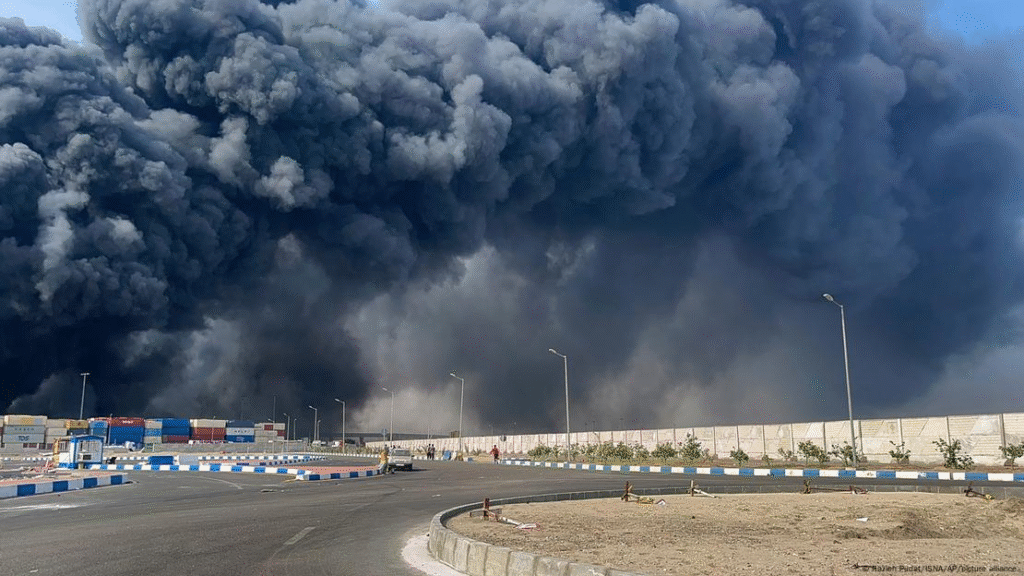
Eskandari points to a serious explosion that occurred at the end of April in the port of Bandar Abbas in southern Iran.
The smoke caused by the combustion of chemical substances released large quantities of soot, nitrogen oxides (NOx), sulfur dioxide (SO₂) and other pollutants, which caused a massive deterioration in air quality in the surrounding areas for several days.