Iran’s regime has executed several people, and arrested hundreds, while seeking to keep domestic opposition in check as its power projection abroad has been weakened following war with Israel.
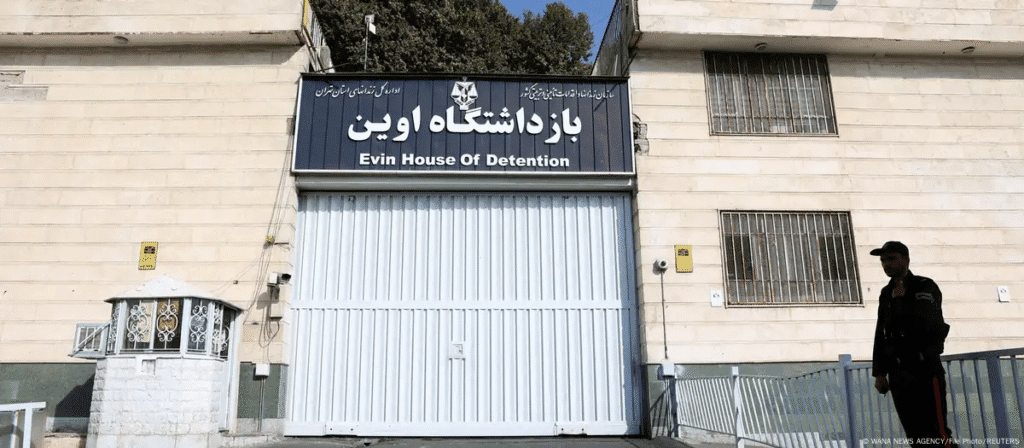
In Tehran’s notorious Evin prison, the Iranian regime locks up its opponents, human rights activists, and political dissidents.
Iranian rights activist and Nobel Peace Prize laureate Narges Mohammadi has spent years behind bars, including multiple stints in Evin prison, for her work calling attention to rights abuses in the Islamic Republic.
On Thursday (June 26), Mohammadi posted on X that she had received a report from a prison inmate about the high-security ward of the prison being mysteriously emptied out directly following Israeli bombardment.
Evin prison’s “Ward 209” is where inmates are held in solitary confinement and interrogations are known to take place under gruesome conditions.
Mohammadi posted that a witness saw men and women being escorted from the ward in grey uniforms, loaded into vehicles, and taken to an unknown location with no information as to their whereabouts or condition. Prisoners from other sections were also said to have been moved in a similar manner.

Iran’s regime expands its net
There is concern that inmates held in secret locations could be mistreated or even killed without anyone knowing.
Three Iranians have already been executed this week. At least two of them had earned their living as smugglers in the Iran-Iraq border region. A court justified the execution by saying that the three men had spied for Israel.
Dieter Karg, an Iran expert at Amnesty International, said the arrests and execution on “spying” accusations, is a sign that the Iranian government is trying to stifle the opposition in the turbulent period following confrontation with Israel.
“The regime is signaling that it is now taking action with full force,” Karg told DW, adding that the regime is moving beyond trying to punish ostensible connections with Israel.
“Rather, it is now also a matter of accusing people who were originally imprisoned for non-political offenses of having political motives,” Karg said.
“In fact, the men who were executed were trying to do nothing more than earn a living by smuggling, and this circumstance is now being exploited for political purposes,” he added.