IMF warned poorer nations hit by the Iran war energy shock may have to cut spending or restructure debt
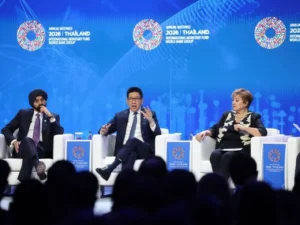
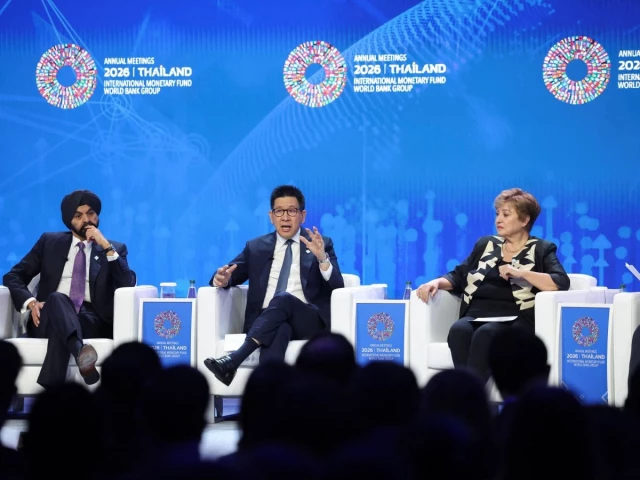
World Bank Group President Ajay Banga, Thailand’s Deputy Prime Minister and Finance Minister Ekniti Nitithanprapas and IMF Managing Director Kristalina Georgieva attend the “Thai Minister of Finance Flagship Event – Building Resilience in a Fragmented World” at the IMF/World Bank 2026 Annual Meetings at Queen Sirikit National Convention Center (QSNCC) in Bangkok, Thailand, October 13, 2026. REUTERS
The International Monetary Fund on Tuesday flagged significant growth and financial stability risks from a potential end to the AI investment boom, growing debt levels and a prolonged Middle East conflict.
The IMF forecast global growth at 3.1% for 2026, a slight uptick from a 3.0% forecast in July as still-strong AI infrastructure investment offset higher oil prices caused by the war in the Middle East.
The latest World Economic Outlook report, released in Bangkok during the annual meetings of the IMF and World Bank, also predicts 3.4% growth in 2027, but that is based on assumptions that the Strait of Hormuz reopens by March and shipping conditions return to the pre-war situation by October 2027.
A more protracted war that kept oil prices above $130 through the first quarter of 2027 would cut growth next year by half a percentage point, the IMF said.
AI correction
In another downside scenario, the IMF said that a steep drop in AI investment could lead to a sharp fall in asset prices, ultimately cutting global GDP by 1.1% by 2028, including a 1.8% drop in US output.
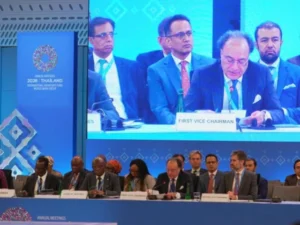
Also Read: Finance Minister Aurangzeb vows to strengthen collective influence of G-24
“We now have an economy that is standing on one leg, the AI leg,” IMF Managing Director Kristalina Georgieva told a Bretton Woods Committee event. “What if it wobbles? What if there is disappointment and that leads to potentially a more difficult environment?”
The IMF emphasised similar risks in its separate Global Financial Stability Report, warning policymakers needed to avoid “complacency” in guarding against a potential pullback in AI investment and stock valuations.
“If there are questions about the monetisation of AI, the equity investments will deplete in value, the debt may be difficult to service, and the revenue commitments in the future may not materialise,” Jason Wu, assistant director of the IMF’s Global Markets Analysis Division, told a press conference at the Bangkok meetings.
An ensuing AI market correction would feed back through the real economy, dragging down broader asset prices and overall demand through a wealth effect reduction, said Athanasios Vamvakidis, deputy director of the IMF’s Monetary and Capital Markets Department.
It would also lead to reduced trade, IMF chief economist Silvana Tenreyro said. Trade in AI goods grew 29% between 2023 and 2025, more than triple the 8.3% growth rate of global trade over the same period. Without the AI trade, overall growth in trade would have been only 4.6%, she said.
The concerns highlighted in Bangkok also include AI-driven cybersecurity risks. They come as banking regulators step up efforts to contain AI-related risks, with Reuters reporting that major US regulators are quizzing banks on their use of advanced AI models and European regulators are pressing banks to boost recovery plans.
Recession unlikely
But even the steep drop in output seen under the worst-case AI risk scenario was not likely to reduce growth to levels consistent with a global recession, IMF deputy research director Petya Koeva Brooks told Reuters in an interview.
Fiscal, bond woes
The IMF reports and meeting participants also highlighted risks from elevated public debt levels and rising bond yields that may be driven higher still by war-driven inflation pressures, eating up budgets to service debts and sapping growth.
Georgieva warned against complacency in “systemically important” advanced economies that are “negligent about their fiscal position” and failing to rein in debts like developing economies have been forced to do.
Developing countries must cut spending despite war shock
The IMF also warned that while low-income developing countries were dealing with the disproportionate impacts of the Iran war-fuelled energy shock, many had “no choice” but to cut spending or potentially face debt restructuring.
Speaking to AFP on the sidelines of the organisation’s Annual Meetings in Bangkok, Brooks said heavily indebted, oil-importing countries were facing the worst of the energy shock, and had difficult choices in helping their citizens through the crisis.
“Unfortunately, after years of the global economy being hit (by) shock after shock, debt levels have increased quite a lot, and at the same time, inflation has become a problem,” she said.
“For those countries that are most vulnerable, this is where the consumption basket is heavily weighted towards energy and food, and so indeed it is much much more difficult,” she added.
Read More: IMF raises inflation forecast to 9.9%
The debt vulnerabilities of many developing economies are a “major barrier” to inclusive growth, said Nigerian Finance Minister Taiwo Oyedele, who chairs the Group of 24 developing nations, warning that member governments were increasingly contending with mounting debt burdens.
Oyedele said estimates showed that developing countries were paying $500 billion more for their debt than developed countries, even as they contend with growing deficits.
The IMF this week is urging countries to begin politically painful steps to bring budgets under control. It singled out Britain for praise as the only major advanced economy to have set out clear plans to reduce government borrowing over the coming years, but urged it to stay the course just weeks before the new UK government unveils budget plans.
Few governments are listening to the IMF’s calls to shrink borrowing, said Josh Lipsky, vice president of international economics at the Atlantic Council, who is attending the Bangkok meetings.
“France, Germany, the US all need to do fiscal consolidation, but they’re moving in the opposite direction,” Lipsky said. “I’m afraid that it’s going to take some kind of crisis to wake up and realise that this is what has to be done.”