



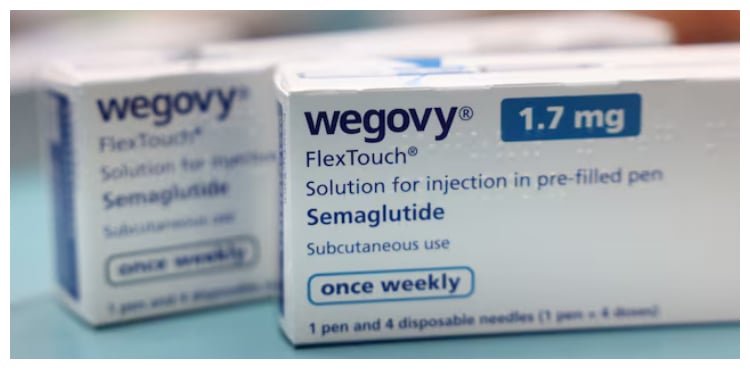
COPENHAGEN, Sept 7: Novo Nordisk said on Monday that in a late-stage trial, 40.4% of children aged 6 to under 12 treated with semaglutide, the active ingredient in its blockbuster weight-loss drug Wegovy, were no longer classified as having obesity after 68 weeks, assuming full adherence to the treatment.
All patients enrolled in the trial, called STEP Young, received lifestyle modification throughout the trial, including a reduced-calorie diet and increased physical activity, Novo said in a statement.
“We are encouraged by the positive STEP Young results and semaglutide’s potential to help children living with obesity who need medical treatment, alongside lifestyle changes, to better manage their obesity,” Novo’s Chief Scientific Officer Martin Holst Lange said.
Novo said the trial met its primary endpoint demonstrating superior body mass index reduction at week 68 in the group taking once-weekly subcutaneous semaglutide compared with the placebo group.
The overall safety and tolerability of semaglutide were consistent with those seen in trials with adults and adolescents, it added.
Prescriptions for GLP-1 weight-loss drugs among U.S. children under 12 have risen more than 300-fold since 2019, a study published Friday found, even though the drugs are not approved for that age group.
About Wegovy
Wegovy is a prescription weight-loss medicine made by Novo Nordisk. The active ingredient is semaglutide, a GLP-1 receptor agonist — the same drug used in Ozempic for diabetes. It works by mimicking a gut hormone that reduces appetite, slows digestion, and helps with blood sugar control.
Wegovy comes in two forms: a once-weekly injection and a once-daily pill. The injection is given under the skin in doses from 0.25 mg up to 2.4 mg for maintenance, with a new higher-dose 7.2 mg “Wegovy HD” approved by the FDA in March 2026 for adults who need more weight loss. The pill version is 25 mg and was approved by the FDA in December 2025, and by the European Commission in July after an EMA recommendation in May. It’s taken in the morning with water and should not be split or crushed. Both forms are used alongside a reduced-calorie diet and exercise for long-term weight management in adults with obesity (BMI ≥30) or overweight (BMI ≥27) with at least one weight-related condition. The pill is already available in the US, UK, UAE, and Germany, with more rollouts planned for the second half of 2026.
In clinical trials, Wegovy has shown significant weight loss. People on the 25 mg pill lost about 17% of body weight on average vs ∼3% on placebo. The higher 7.2 mg injection produced about 19-21% average weight loss over 72 weeks, with nearly 1 in 3 participants losing 25% or more. Beyond weight, Wegovy is also approved to reduce the risk of major cardiovascular events in adults with obesity/overweight and established heart disease, and a 2.4 mg injection is approved for MASH, a serious liver disease.
Common side effects are similar to other GLP-1 drugs: nausea, vomiting, diarrhea, constipation, and abdominal pain. With the 7.2 mg dose, rates of GI issues and unusual skin sensations like tingling were higher. Treatment discontinuation due to side effects was around 6.9% for the pill. Novo positions the pill as a simpler option for people who prefer tablets over injections, and the company estimates the Wegovy pill has captured most of the oral obesity market so far.