



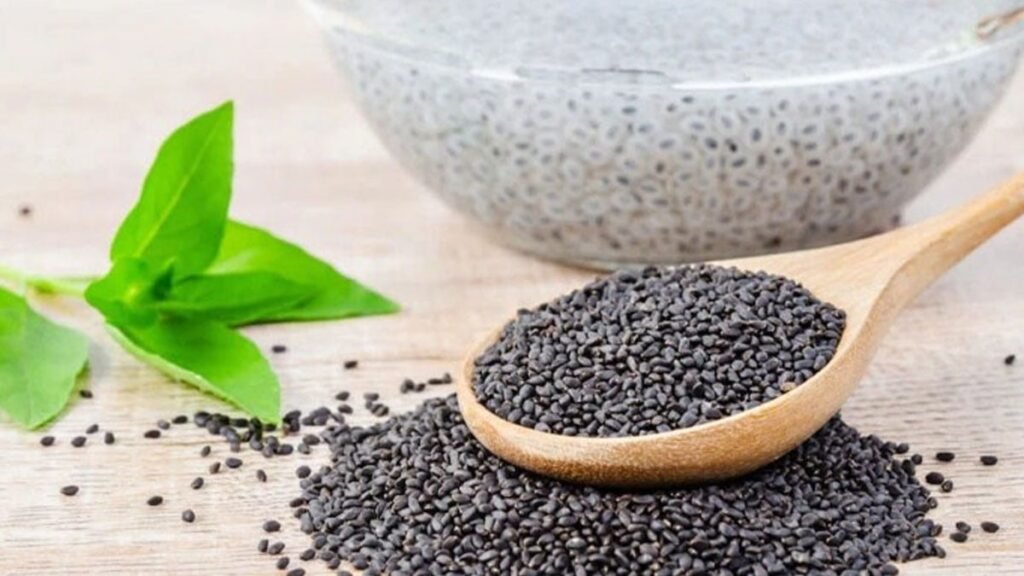
Once hailed as being overhyped during their 15 minutes of fame, tiny black seeds of the basil plant-commonly known as sabja or Tukmaria-have reemerged with renewed vigor as a dietary superfood.
Here, we unpack the health claims associated with basil seeds, and what you-realistically-can expect when you consume them by providing an analysis of what’s actually beneficial to your lipid profile, blood sugar, digestive system and what myths you need to throw out to the garbage bin thanks to Dr. Saurabh Sethi, Harvard- and Stanford-trained gastroenterologist.
So, to recap the key health benefits of eating basil seeds (sabja):
1. Help Lower cholesterol and control blood sugar:
Basil seeds, in fact, offer tremendous amounts of soluble fiber. Especially pectin- the fiber that forms a gel- when eaten traps with cholesterol and bile acids in your intestines for efficient expulsion from the body, before they enter your bloodstream. Also, the soluble fiber component, prevents sharp rise in post-meal blood sugar.
2. Gut Health and relieve Constipation:
When combined with fluid, basil seeds form an enlarged covering made from the mucilaginous fiber that is released when they swell. Thus increasing the stool bulk, prompting regularity and assisting in a happy gut microbiome.
3. Control Appetite & aid Hydration:
They delay the emptying of the stomach making you feel fuller for longer (satiating) assisting in weight loss. Holding almost 10-12x their weight of water they assist in keeping you hydrated.
4. Rich in Micronutrients:
Just a tablespoon (about 13 gm) serving of basil seeds containing approximately 40-50 calories while supplying the body with all the essential micro-nutrients required and included:
Calcium & Magnesium: which are vital for adequate bone mineral density.
Iron: to help increase oxygen transport in your blood.
Polyphenols: bioactives known to fight free-radical damage by acting as anti-inflammatory agents.
How to add basil seeds to your diet safely:
To experience the maximal health benefits offered by basil seeds and to avoid any stomach aches/discomfort from eating them raw (as some seeds expand in your gut and if eaten with very little liquid), follow simple preparation:
Combine 1 to 2 teaspoons of dry basil seeds with 1 cup of cool or lukewarm water.
Let them steep for about 15-20 minutes or until all the seeds have completely expanded and taken on translucent, gel-covered, pearl-like bodies.
Consume. The most popular options:
A. As a drink; combined with lime juice or a little honey.
B. Blended; put the steeped seeds directly into any smoothie.
C. Added; to the top of your bowl of yogurt or oats, or incorporated into the ingredients for chia pudding.