
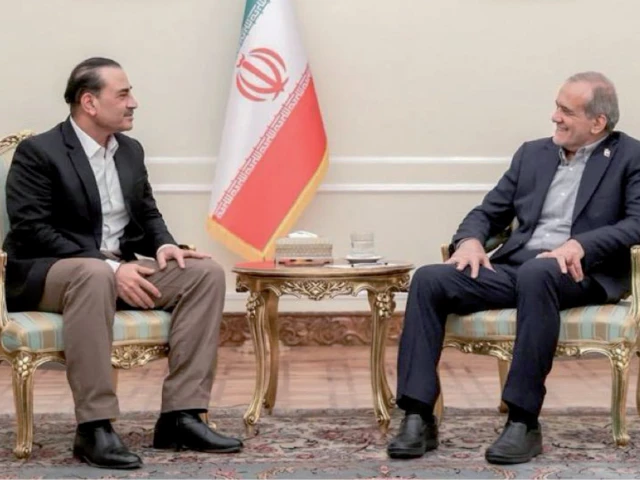
Field Marshal Munir holds high-level talks in Tehran, urges de-escalation and reopening of the Strait of Hormuz
Army Chief Field Marshal Asim Munir speaks with Iranian President Masoud Pezeshkian during a meeting in Tehran. PHOTO: EXPRESS
ISLAMABAD:
Chief of Defence Forces (CDF) Field Marshal Syed Asim Munir during his day-long visit to Tehran on Monday pushed for breaking the stalemate in the ongoing US-Iran conflict, reopening the Strait of Hormuz and finding a negotiated settlement to end the conflict and wider regional instability, according to Pakistan’s official readout.
The statement by the Inter-Services Public Relations (ISPR) provided the first detailed official account of Field Marshal Munir’s high-level engagements in Tehran amid Pakistan’s renewed diplomatic efforts to revive dialogue between Washington and Tehran.
According to ISPR, the CDF and Interior Minister Mohsin Naqvi held “comprehensive discussions” with Iran’s top political and security leadership on measures to prevent further escalation, reopen the strategic Strait of Hormuz and bring about an “expedited termination” of the conflict.
The Pakistani military said the two sides also exchanged views on regional peace and explored ways to reach a negotiated settlement to the disputes.
“The visit was part of Pakistan’s diplomatic efforts to end the stalemate in the ongoing US-Iran conflict and explore ways for achieving enduring peace and permanent end to instability in the region,” ISPR said in a statement issued at the conclusion of daylong trip.
He held separate meetings with Iranian President Masoud Pezeshkian, Mohsen Rezaei, the representative of Supreme Leader Ayatollah Mojtaba Khamenei on the Supreme National Security Council, Parliament Speaker Mohammad Bagher Ghalibaf, Foreign Minister Abbas Araghchi and Interior Minister Eskandar Momeni.
The Iranian leadership, according to ISPR, appreciated Pakistan’s “constructive role and sincere efforts” to facilitate dialogue, de-escalation and a peaceful resolution of the conflict.
Munir’s visit came at a particularly sensitive moment, with the United States threatening tougher economic measures against Iran and warning countries providing economic lifelines to Tehran of potential consequences.
The trip also followed a reported telephone conversation between Munir and US President Donald Trump last week. Reuters, citing three Pakistani sources, reported that Trump had initiated the call and that one source said the main US request was for Pakistan to use its influence to bring Iran back to negotiations.
The reported conversation had not previously been disclosed publicly. The White House did not immediately respond to Reuters’ request for comment.
Field Marshal Munir’s Tehran visit was widely seen as an attempt by Islamabad to engage both sides and prevent the collapse of the diplomatic process that Pakistan had helped facilitate earlier this year.
Pakistan had played a key role in brokering the Islamabad Memorandum of Understanding between the US and Iran. However, the 60-day window envisaged under the understanding passed without a durable breakthrough, while renewed hostilities further deepened the trust deficit between Washington and Tehran.
Iranian officials blamed the United States for violating commitments under the Islamabad MoU. During his meeting with the Field Marshal, Ghalibaf, who also heads Iran’s negotiating team, said Washington had undermined regional stability by failing to honour its commitments under the understanding.
Iranian officials also stressed during Munir’s meetings that Tehran remained committed to the MoU but expected the US to fulfil its obligations.
Rezaei, meanwhile, said Iran distrusted the United States and called for Washington to change its behaviour and take practical steps to implement the understanding, according to Iran’s official IRNA news agency.
The Strait of Hormuz emerged as another key issue during the Pakistani military chief’s visit. The waterway is critical to global energy supplies, and any prolonged disruption could have serious consequences for regional economies and international oil markets. Iran has repeatedly warned of measures affecting the Strait amid the escalating confrontation with the United States.
Pakistan’s latest diplomatic push therefore appears to have two immediate objectives: preventing further escalation and creating conditions for the reopening of the Strait of Hormuz alongside the revival of direct negotiations.
ISPR said Munir and Naqvi were received upon arrival by Iranian Interior Minister Eskandar Momeni and other senior Iranian civil and military officials. The visit also underscored the unusual diplomatic role being played by Pakistan as it attempts to maintain communication with both Washington and Tehran.
Islamabad has sought to leverage its relations with the two countries to promote a negotiated settlement, while simultaneously trying to shield the region from the economic and security consequences of a prolonged conflict.
Munir’s latest visit was his fourth trip to Tehran since the Iran-US conflict erupted, reflecting the importance Pakistan attaches to keeping channels of communication open with the Iranian leadership.
With President Trump seeking to increase pressure on Tehran and Iran insisting that it will not accept negotiations without guarantees and concrete commitments from Washington, Pakistan’s mediation effort faces significant challenges.
The detailed account provided by ISPR nevertheless indicates that Islamabad is continuing to pursue diplomacy, with the reopening of the Strait of Hormuz and an end to the conflict now emerging as central elements of Pakistan’s latest initiative.