



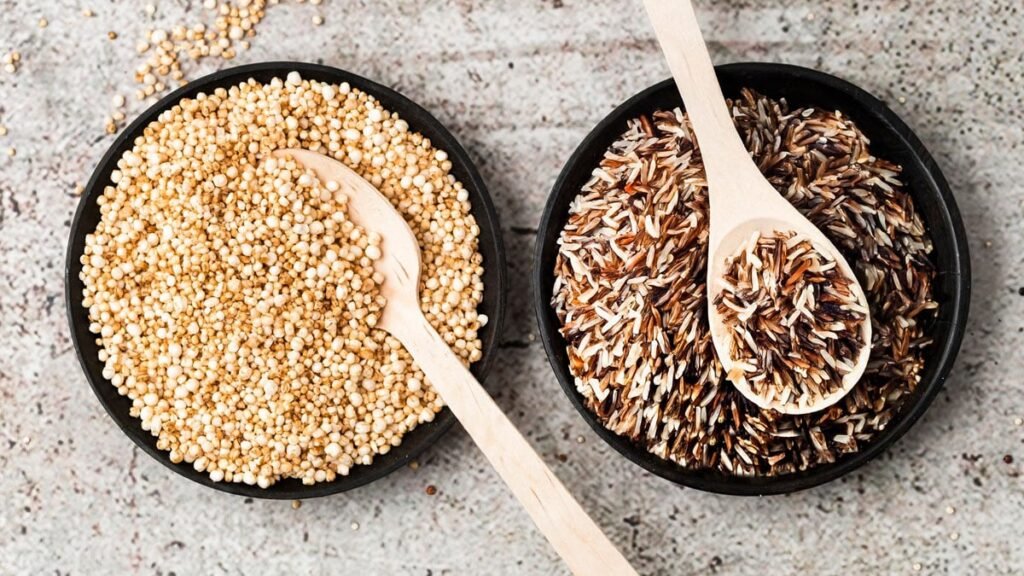
In terms of whole grains that can be healthy for meal prep, brown rice and quinoa come in hot. Both grains are a good source of nutrients and carbohydrates.
However, if you are looking to manage the rise in your blood sugar levels or if you eat a low-glycemic diet, perhaps you wonder: Does one have a definite edge?
The short answer is: it seems so, with quinoa emerging as slightly better choice due to its protein and fiber content. But there are other factors such as how much you serve, what else you include in the meal and how much you prepare that plays a significant role. Keep reading to get a well-researched glimpse of how brown rice and quinoa impact our glucose levels.
The Glycemic Index (GI) What The Glycemic Index?
The Glycemic Index (GI) is a scale ranking foods containing carbohydrates according to how rapidly they rise blood glucose compared with pure glucose.
If looking purely at a food GI, brown rice and quinoa are almost identical. For brown rice: its GI is about 50 to 55 (considered low to medium) For quinoa: its GI is about 53 (considered low) Though The GI has them playing a fairly even match. Brown rice and Quinoa GI Factors to keep in mind: A higher GI for one is not the be all and end all.
The actual impact your food has on blood glucose depends on how you prepare, process, and cook it – and even on how you store it .
1. Macronutrient Comparison What a Macronutrient?
What Macronutrients really do is determine how quickly your carbohydrate food breaks down and is used as sugar by your bloodstream.
Both protein and fiber slow down the digestion of food, and keep steady the rise in your blood sugar.
Breakdown per Cup Of: nutrientbrown rice (1 cup cooked) quinoa (1 cup cooked) Protein5grams8grams Fiber3.5 grams 5grams As you can see, quinoa has a great deal more fiber and even more protein per 1 cup serving.
This means that for us that are eating for blood sugar management, even over the long run, we can expect a more moderate and consistent increase in our blood sugar as opposed to a more rapid rise with brown rice.
Additionally, quinoa happens to be a complete protein which means that the body contains all nine essential amino acids.
2. Resistant Starch “Leftovers” can Help Here is what most people don’t realize; if you want to control blood sugar level that meal that contained carbs is best cooked fresh.
However, you can make it into meal preparation food as well.
When you cook carbs, either you cook brown rice or quinoa, if you let them cool and do this.A process takes hold where a regular starch is transformed into a resistant starch as they sit and are refrigerated.
What Is Resistant Starch?
Resistant starch, when processed this way, actually serves as fuel for beneficial digestive bacteria and mimics soluble fiber by resists being broken down and being taken up in the upper parts of our intestines.
How Does This Effect Our Blood Sugar?
Because resistant starch is not broken down at the top of the intestine, it slows the progress down of the carbohydrates as far down as that middle of our gut before any is released to become blood sugar.
The 2 “Leftover” grains that offer a good source of resistant starch arebrown rice and QuinoaTip: if you choose to make either of these the “overnight option” just warm up when time to eat the and enjoy a healthy choice!
3. How Do I Cook My Quinoa Or Brown Rice If I AM Cooking Food For Blood Sugar Management?
While quinoa has a few extra miles on the “better option”, when you factor in these considerations. Watch portion size, don’t use either grain in excess as it will raise your blood glucose.
It is best to keep grains at around a ¼ slice of your plate if you eat grains at any time. Balance grains with healthy fats, and or proteins and in doing so your glucose is lowered, at least in the first half of the meal it goes up to its lower more normal level then that’s it!!!
Swap out for highly processed carbohydrates such as white bread, and white pasta if possible.