
Iranian forces brought ‘most heavily armed military’ to its knees: IRGC commander
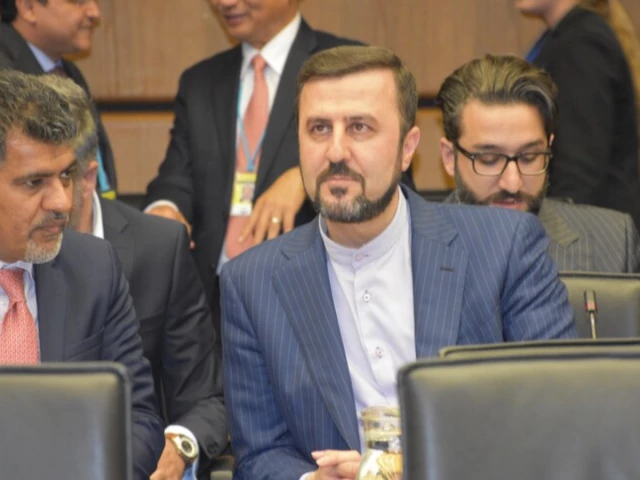
Deputy Foreign Minister Kazem Gharibabadi is pictured here on the right. PHOTO: ANADOLU AGENCY
Iranian Deputy Foreign Minister for Legal and International Affairs Kazem Gharibabadi on Saturday rejected US President Donald Trump’s claims regarding the Strait of Hormuz, stressing that Iran retains authority over the strategic waterway.
Gharibabadi stated on X that “The Strait of Hormuz cannot be seized by tweet, nor by aircraft carrier, nor by issuing an order, nor by an election speech. Iran neither fears threats nor cowers before displays of power.”
ترامپ گفته بعد از شکست ایران، بزودی تنگه هرمز را قلمرو آمریکا اعلام خواهد کرد!
تنگه هرمز را نه با توییت میتوان تصاحب کرد و نه با ناو هواپیمابر، نه با صدور فرمان و نه با سخنرانی انتخاباتی. ایران نه از تهدید می هراسد و نه با نمایش قدرت مرعوب میشود. (۱)— Gharibabadi (@Gharibabadi) August 14, 2026
Gharibabadi responded to Trump’s claim that the US might soon declare the Strait of Hormuz US territory following what he described as Iran’s defeat.
In the X thread, Gharibabadi said the waterway had been Iranian, remained Iranian, and would continue to be so, saying that it could only be closed or reopened under Iran’s command.
Read: Iran ‘agrees on general principles’ to restrict US, Israeli vessels from Strait of Hormuz: Tasnim
He also said Iran would ” continue to enforce the blockade” as long as the United States failed to acknowledge its strategic defeats and continued delusional claims.
Iranian forces brought ‘most heavily armed military’ to its knees: IRGC commander
The commander of the Islamic Revolution Guards Corps (IRGC) Brigadier General Ahmad Vahidi praised Iran’s military personnel for six months of sustained fighting, noting that their operations brought the world’s “most heavily armed military to its knees”, according to IRNA.
Vahidi in his message addressed members of the IRGC, Army, Law Enforcement Command, Basij, tribal forces, and other security personnel, praising their endurance and battlefield performance.
Vahidi said the forces’ six-month campaign had demonstrated resistance against one of the “most brutal enemies of humanity”, according to IRNA. He added that their performance had “strengthened hopes among oppressed peoples for an eventual end to domination by powerful states”.
Ghalibaf ‘suspended negotiations’ in light of assault on Dahiyeh
Iranian Parliament Speaker Mohammed Bagher Ghalibaf said that he “suspended the negotiations” in light of “the most recent assault on Dahiyeh.”
Parliament Speaker @mb_ghalibaf: During the most recent assault on Dahiyeh, I suspended the negotiations and declared that we would retaliate against the regime that very night and that any response from them would be met with strikes across the entire region. pic.twitter.com/fgpG4sGmnf
— IRNA News Agency ☫ (@IrnaEnglish) August 15, 2026
He declared that Iran would “retaliate against the regime that very night and that any response from them would be met with strikes across the entire region.”
Trump was ‘joking’ about declaring Strait of Hormuz US territory: US media
US President Donald Trump was “joking” when he said he would declare the Strait of Hormuz a US territory after the war with Iran, US media reported on Friday.
Trump has not met with his advisers to discuss such a move, Wall Street Journal reporter Brian Schwartz said through US social media platform X, citing an unnamed senior White House official.
“President Trump has not met with his advisers about declaring the Strait of Hormuz a US territory post the war and was joking during his speech today in New York,” Schwartz wrote.
Trump made the remark during a political rally at the Nassau County Police Academy in Garden City, New York.
“After we finish defeating Iran, which is being very badly defeated — pretty soon I’ll be declaring the Hormuz Strait a territory of the United States,” he said with a chuckle. “It’s true,” he added.
Read more: Hormuz shipping traffic capped amid competing claims from US and Iran
Schwartz, who attended the speech, said Trump chuckled after remarking but then appeared to insist that it was true.
Trump also claimed that Washington controls maritime access through the strategically vital waterway.
“We have the blockade. No ships get through unless we want them to,” he told supporters.
Iran disputes US control claims
Iranian military officials have disputed the claim, with Iran’s central military command on Thursday calling assertions of US control over the waterway “baseless lies and fabrications.”
As of August 12, some 3,371 vessels had crossed the strait in the 166 days since the war began, representing around 20% of pre-war traffic volumes, according to data from commodities and shipping analytics firm Kpler cited by CNN.
The US and Iran had agreed to a Pakistan-brokered ceasefire in April and later signed a deal on June 17 to launch negotiations toward a final agreement. However, the talks subsequently stalled over disagreements including security guarantees and freedom of navigation through the Strait of Hormuz.
Also read: Trump confirms USS Abraham Lincoln to be replaced in Middle East
The two sides also exchanged military strikes from July 8 to 24, with Washington attacking targets inside Iran, and Tehran responding with strikes on what it described as US military facilities and equipment in several Arab countries, including Jordan, Bahrain, and Kuwait.
The Strait of Hormuz connects the Gulf with the Gulf of Oman and is one of the world’s most important energy shipping routes.
Iran defiant on strait as Trump tells Americans to accept high gas prices
Iran called on the US to accept defeat while President Donald Trump blasted Tehran as “very evil” and told Americans to brace for continued high fuel prices as a result of the war.
Progress toward peace talks and oil tanker traffic through the strategic Strait of Hormuz waterway remained halted, with no sign the warring parties were moving toward ending the conflict that the US and Israel launched on February 28.
US gasoline up 29% on year, Iran also feels impact
Foreign Minister Abbas Araghchi said Iran had not decided to resume talks with the US He told Iranian news outlet Shahrara News in an interview published on Saturday that Washington must meet conditions on the strait in order for shipping to resume in the waterway that handled one-fifth of the world’s oil before the war.
Trump urged Americans to accept slightly higher gasoline prices while the conflict with Iran continues.
He told a political rally in Garden City, New York, on Friday that paying “a tiny little bit more for your gasoline” is worth the cost of ensuring “a very evil country” could not have a nuclear weapon, one of the president’s stated rationales for the war.
In a trend that has sparked inflation and disappointed voters, the average US price of a gallon of gasoline was about $4.08 on Friday, up 29% from a year earlier, according to the American Automobile Association.
Trump, a Republican, campaigned for reelection on a promise to lower energy costs, and Democrats are seeking to make the war’s fallout an issue in November congressional elections.
Crude oil futures rose $1 a barrel on Friday. Benchmark Brent futures were on track for a weekly rise of 6.0% and West Texas Intermediate 5.4%.
“The Strait of Hormuz cannot be seized by a tweet or an aircraft carrier, by issuing an order or by delivering an election speech,” Gharibabadi said.
Despite Iran’s defiant tone, though, there were signs of an economic toll there too.
President Masoud Pezeshkian, in remarks on state television, blamed high inflation on a US blockade of Iranian ports and sanctions on Iran’s oil exports.
No crude oil vessels transiting Strait
Trump and Treasury Secretary Scott Bessent each pledged to inflict more financial damage on Iran. Bessent told Newsmax’s “Rob Schmitt Tonight” program on Thursday that announcements of more measures against Iran were coming next week.
Tehran calls its enforcement of strait traffic a blockade – the term Washington uses for its threat against Iranian vessels leaving their ports.
“What we’re doing is a great service for the world, not only for ourselves … and we’re really doing a great job,” Trump said, adding that a 260-day deployment by a US aircraft carrier supporting the war effort was “not nearly long enough.”
Only two vessels passed through the Strait of Hormuz on Friday with no crude oil shipments visible, according to analysis from ship-tracking firm Kpler. Some ships may cross the strait undetected with their transponders off, but the figures are nowhere near the more than 130 ships that traversed it daily before the war.
Vessels that dare navigate the strait without Iranian permission risk missile or drone strikes. The United Arab Emirates’ Abu Dhabi National Oil Company said two of its vessels were attacked transiting the strait on Thursday evening, and the Emirati state news agency WAM reported another vessel came under attack on Friday.
A bulk carrier was struck in the hull by an unknown projectile in the Strait of Hormuz on Friday, the United Kingdom Maritime Trade Operations Centre said on Saturday, adding that the crew were safe, no damage assessment had been reported and that the environmental impact was unknown.
A tentative June deal to end the war is in tatters.
“We did not have a ceasefire in the first place that we would now want to extend,” Araghchi said. “We had ‘the end of the war,’ and now there is a new situation.”
Attacks by Houthis in Yemen renewed concerns about a widening regional war. Yemen’s internationally recognised government said the Houthis fired six ballistic missiles at the Red Sea port of Mocha on Friday, killing four civilians.
The Houthi-run SABA news agency cited a military source as saying the group had targeted an Aramco facility in the Saudi city of Najran with a drone.