Three-way defence pact designed to provide deterrence; Iran and its allies challenge Saudi efforts to show restraint
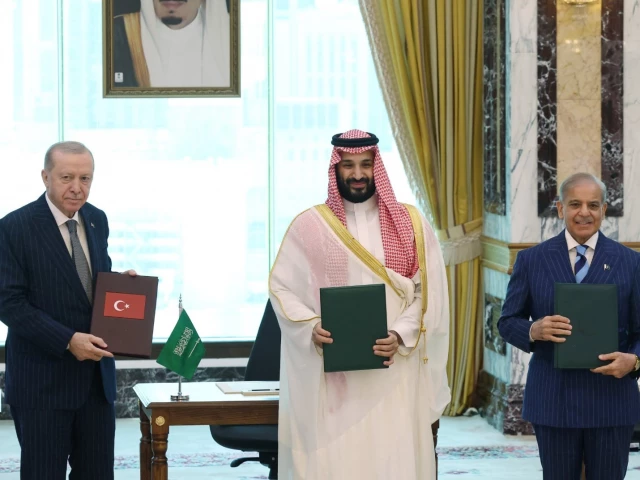
Turkish President Tayyip Erdogan, Saudi Crown Prince Mohammed bin Salman and Prime Minister Shehbaz Sharif pose after signing a joint defence agreement in Makkah, Saudi Arabia on August 7, 2026. PHOTO: REUTERS
Increasingly dragged into a war it did not choose, Saudi Arabia is building regional defensive alliances that it hopes will keep its enemies at bay and help it respond more robustly to attacks by Iran and its network of regional allies.
But nascent attempts to construct a multinational maritime coalition in the Red Sea, and the decision to bring Turkiye into a defence pact with the kingdom and Pakistan, have so far failed to ward off attacks, analysts and diplomats said.
The kingdom’s own military responses to attacks from Iran, Iraq and from Yemen’s Houthis, who last month opened a southern front against the kingdom and have attacked Saudi shipping, have so far been limited.
Read: Pakistan, Saudi Arabia, Turkiye sign joint defence pact in Makkah
Riyadh faces a dilemma: how to deter attacks and protect the ambitious economic vision it is pursuing without becoming entangled in a broader conflict in the region sparked by the war between the US and Iran.
As one Middle Eastern official put it, “Saudi Arabia’s problem is that the kingdom’s enemies know it wants to avoid war. They are abusing that.”
The Saudi government media office did not respond to a request for comment for this story.
“This is all very concerning and is exactly what Saudi Arabia wanted to avoid,” said Aziz al-Ghashian, a Saudi analyst and senior non-resident fellow at the Gulf International Forum.
“Iran and its affiliates think Saudi won’t respond. They understood restraint as basically an acceptance of being targeted, and this is why it was very important for Saudi to find a way to deter them. The trick is how to balance it,” he said.
After the defence pact was signed, the Houthis again attacked oil installations in the kingdom.
Gradual escalation
Since the US and Israel launched the war on Iran on February 28, Saudi Arabia has tried to absorb attacks, choosing to first pursue a purely diplomatic path before beginning limited military responses that were kept secret.
It reached a tentative calm with Iran around the time an April ceasefire with the US went into effect and emerged as a safer haven in the Gulf.
The past few weeks have jeopardised much of that.
The kingdom has faced damaging attacks on critical oil infrastructure from Yemen and Iraq, as well as on its shipping via the Strait of Hormuz and the Red Sea.
Also Read: What the Pakistan-Saudi Arabia-Turkiye defence pact is — and what it isn’t
Two weeks ago, Saudi Arabia and the US launched joint airstrikes targeting Iraqi militias they said were involved in the attacks on the kingdom. It was the first retaliation announced by the kingdom during the war, and came despite the Saudis having sought to avoid being seen as a co-belligerent with the US and Israel.
Two days later, Riyadh announced its intention to lead a maritime defence coalition in the Red Sea.
Last week, it announced the joint defence agreement with Turkey and Pakistan in Makkah.
“This is Saudi Arabia’s way to signal to Iran that we are willing to go further up the ladder, of course [first that] of diplomacy before crossing the line of diplomacy to the other side,” said Yasmine Farouk, project director for the Gulf and the Arabian Peninsula at Crisis Group.
“The way I see this pact and coalition is [Saudi] incrementally reaching the final stages of de-escalatory and deterrence policies,” she said, while still noting the coalitions were “trial balloons” and joint military action was currently unlikely.
Makkah defence agreement
Announced at Makkah after Friday prayers, the Saudi-Turkiye-Pakistan defence agreement carries the symbolic weight of Muslim nations pledging to defend each other as if they were one Muslim nation, according to Sultan Alamer, a non-resident scholar in the Carnegie Middle East Programme.
But in practice, the roles appear less clear.
On Saturday, Turkish Foreign Minister Hakan Fidan said the pact was technically the same as NATO’s Article 5 and would require consultations among all parties to determine what sort of support to provide to any attacked country, if it asks for any.
Islamabad, under its pre-existing defence pact with Saudi Arabia, had sought to avoid becoming engaged militarily with Iran or its allies and managed to do so despite Saudi Arabia facing hundreds of missile and drone attacks.
Iran has framed the agreement as a step away from reliance on outside powers, apparently a reference to the United States, and said it saw no reason to be concerned, “so long as it correctly identifies the enemy and the threat”.
The Yemen headache
On Saudi Arabia’s southern border, Yemen’s Houthis last month ended a four-year truce, declaring a naval blockade on the kingdom and firing on its oil infrastructure.
The Houthi attacks have shown the kingdom’s continued vulnerability to asymmetric warfare and revived memories of the 2019 crisis when Saudi oil production halved after Houthi drone and missile attacks that were planned by Iran, according to Reuters reporting.
Yemen is a particular sore spot for the kingdom, which led a military intervention in 2015 after the Houthis stormed the capital Sanaa, resulting in an international outcry over the high toll from war and famine.
Read More: Inside the Makkah defence pact and its regional implications
With Yemen once again edging towards war, Riyadh this time wants the Yemeni government to lead any offensive that takes place and had said a multi-national maritime coalition was needed to defend Red Sea shipping.
Invitations were sent out just a few days before the first meeting; several people who attended said so, showing the urgency with which Saudi was approaching the mission.
So far, 14 regional countries have signed on, with more expected to join. Western diplomats say European nations are still deliberating whether to join, concerned about how far they would potentially become involved in a war in Yemen.
Saudi Arabia wants to announce its official formation as soon as possible, with meetings planned this week in Jeddah.