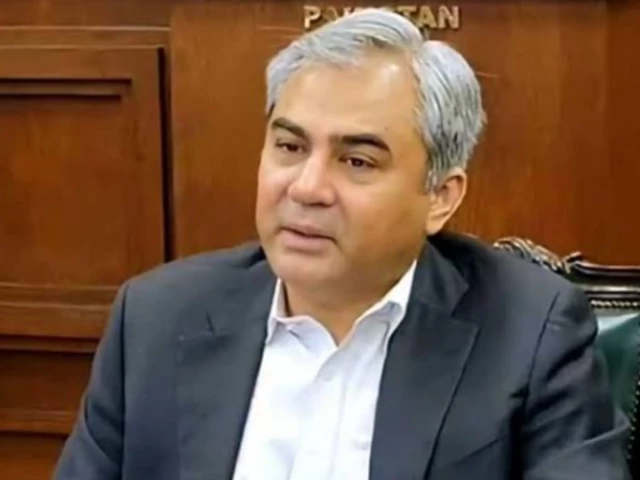
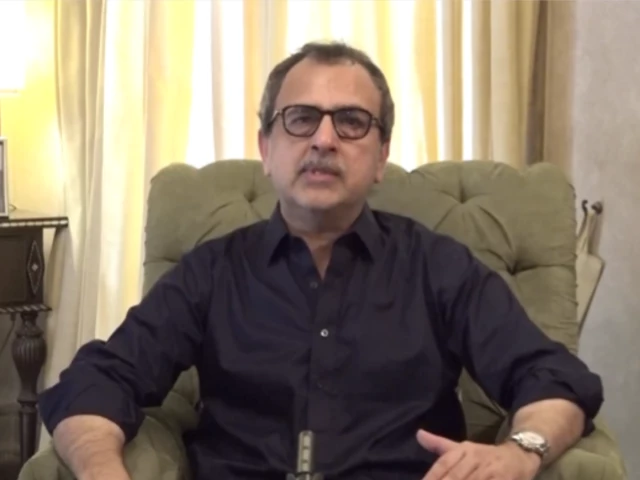
Energy Minister Awais Leghari speaking in a video message. SCREENGRAB
ISLAMABAD:
Federal Minister for Power Awais Leghari on Tuesday unveiled an ambitious roadmap to increase clean electricity’s share in Pakistan’s power mix to 90 per cent by 2035.
He also revealed that limitations under the country’s IMF programme prevent the government from introducing a market-based electricity tariff system that could lower power costs and accelerate the clean energy transition.
Addressing the Solar, Storage and Flexibility 2026 Conference, he said the government was shifting decisively from a generation-first approach to one focused on grid flexibility, energy sovereignty and local industry to protect consumers from international fuel price shocks and capitalise on Pakistan’s rapidly expanding rooftop solar sector.
Leghari said Pakistan had entered a new energy era with nearly 38 gigawatts of distributed solar capacity installed on rooftops through consumer-led investment.
He described the rapid expansion of private solar generation as both an opportunity and a challenge, noting that while the country enjoys abundant solar power during the day, it lacks the storage infrastructure needed to shift surplus electricity to evening peak hours.
He referred to disruptions in RLNG supplies earlier this year as a reminder of Pakistan’s vulnerability to imported fuels, saying the outages exposed a strategic weakness by causing load shedding despite sufficient solar generation during the day.
“Battery storage is not an optional add-on. It is a strategic asset for our energy sovereignty,” he said.
Leghari said clean energy sources, including hydropower, nuclear, wind and solar, currently account for around 55 per cent of Pakistan’s electricity generation.
However, he warned that without major investments in battery storage, transmission infrastructure and electricity market reforms, the country’s renewable energy ambitions would remain disconnected from a reliable power supply.
“Ambitious renewable targets must be matched by commensurate investment in storage; otherwise renewables will remain intermittent promises, not bankable power,” he said.
The minister outlined a three-pronged strategy to achieve the government’s objectives: expanding battery energy storage systems across the national grid, promoting local battery assembly and manufacturing to reduce import dependence and create jobs, and introducing regulatory reforms to provide long-term certainty for investors.
Later, during an interactive session, Leghari disclosed that restrictions under Pakistan’s IMF programme were preventing the government from introducing a flexible, market-based electricity tariff system that would allow power prices to reflect the actual cost of electricity at different times of the day.
He said the government has been engaged with the IMF for several months to introduce a time-of-use tariff under which electricity would be priced according to hourly generation costs.