
Data shows attacks on mosques in the occupied West Bank surged over the past decade, with a sharp rise after Oct 2023
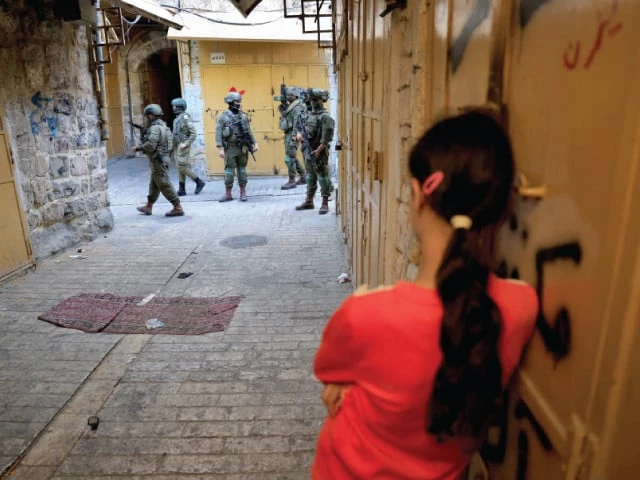
A Palestinian girl waits to pass as Israeli settlers take part in a weekly tour in Hebron, in the Israeli-occupied West Bank—REUTERS
In the early hours of July 26, the quiet of the occupied West Bank was shattered once again. Illegal occupiers, backed by Israeli forces, launched coordinated raids targeting Palestinian villages.
In Qusra, a village in the Nablus governorate, the newly constructed Al-Rahma mosque was burned. Its walls were defaced with Hebrew graffiti demanding “revenge”.
In the nearby village of Kur, occupiers stormed the village and set fire to a mosque, causing partial damage to the building and its interior.
The attacks came amid a wider escalation of occupier violence across the West Bank.
However, targeting mosques is not a new playbook.
Over the last decade, Israeli extremist occupiers and security forces have drastically increased attacks on Palestinian mosques across the occupied West Bank and East Jerusalem.
According to the Armed Conflict Location and Event Data Project (ACLED) and Anadolu data, there have been 62 mosque-related incidents recorded between 2017 and mid-2026.
An analysis of data compiled by ACLED also shows that attacks on Palestinian mosques have increased significantly over the past decade, with a particularly sharp rise after October 2023.
Between 2017 and 2022, there were 25 incidents targeting Palestinian mosques, an average of about four attacks per year.
From 2023 through July 2026, the number rose to 35 incidents in just three and a half years, pushing the yearly average to 10 attacks.
2026 has had the highest number of attacks since 2017, with 11 incidents reported so far.
The Palestinian Ministry of Endowments and Religious Affairs said that 13 mosques have been violated by Israeli forces and occupiers since the beginning of 2026.
In its 2025 report on Israeli violations against Islamic and Christian sites, the ministry said Israeli forces and occupiers attacked 45 mosques across the West Bank and East Jerusalem, either through partial destruction of facilities or by desecrating them via incursions and mocking Islamic rituals.
The pattern has also changed.
What once registered as sporadic acts of vandalism has evolved into a frequent, coordinated campaign.
Earlier attacks mainly involved racist graffiti, vandalism and attempted arson, but recently mosques and religious properties were burned, copies of the Quran were desecrated, and worshippers were attacked.
2017-2018: Arson and ‘price tag’ attacks increase
In 2017, ACLED recorded two incidents targeting Palestinian mosques and religious sites.
On Oct 12, dozens of occupiers attacked Palestinian property in the Old City of East Jerusalem as they moved towards the Al-Aqsa Mosque compound under Israeli forces’ protection, and stormed it.
Three days later, on Oct 15, occupiers attempted to set fire to a mosque in Tuwani village in Hebron, in the occupied West Bank.
Five mosque-related incidents were recorded in 2018.
On April 13, Israeli occupiers set fire to a mosque in Aqraba village near Nablus, destroying the building. The attackers left Hebrew graffiti on the walls, including the words “death” and “price tag”.
On July 27, Israeli police closed Al-Aqsa Mosque in East Jerusalem for several hours after clashes erupted between Palestinian worshippers and Israeli occupiers.
Occupiers on Oct 3 attacked residents and attempted to set fire to the village mosque at Tuwani, Hebron.
On Nov 30, Israeli occupiers raided Jaba village in Jenin, spray-painting anti-Arab slogans in Hebrew on the walls of a local mosque and several Palestinian homes.
In December, occupiers carried out another suspected “price tag” attack in Yasuf village, spray-painting Hebrew slogans on a mosque and homes.
2019: Highest annual total before Gaza war
The number of attacks rose sharply in 2019, with nine incidents recorded.
In January, occupiers, under Israeli forces’ protection, cut branches from olive trees in the garden of the Ibrahimi Mosque in Hebron.
On Feb 4, occupiers attempted to set fire to a mosque in Dayr Dibwan near Ramallah, while spray-painting anti-Arab graffiti on its walls during a suspected “price tag” attack.
Six days later, on Feb 10, Israeli forces detained several Palestinians after the occupiers assaulted worshippers at Al-Aqsa Mosque.
On Feb 14, occupiers, accompanied by Israeli forces, painted racist Hebrew slogans at a mosque in Iskaka village near Salfit.
On March 19, they spray-painted anti-Arab slogans on a mosque in Battir village near Bethlehem.
Three days later, on March 22, occupiers returned to Battir and again sprayed racist graffiti, including a Star of David symbol, on Palestinian property.
On April 8, Israeli authorities sealed the entrance of the Sheikh Makki Mosque in East Jerusalem, using adhesive material and nails.
Around April 9, clashes broke out near the Mughrabi Gate in East Jerusalem after dozens of Israeli occupiers entered the Al-Aqsa Mosque compound under Israeli forces’ protection.
On June 12, occupiers from the Yitzhar settlement raided Aynabus village near Nablus, punctured vehicle tyres and painted racist slogans on the walls of a mosque.
2020–2021: Continued arson and vandalism
Three incidents were recorded in 2020, followed by one in 2021.
On Jan 24, 2020, Israeli occupiers set fire to a mosque in Bayt Safafa, south of Jerusalem, and wrote anti-Arab slogans on the walls.
Two days later, occupiers torched the historic Badriya Mosque in Sharafat, near Bayt Safafa in occupied East Jerusalem.
On July 27, a Palestinian mosque in Al-Bireh was burned by occupiers who also spray-painted racist slogans on its walls.
The same month, Israeli occupiers attacked and damaged the windows of Hassan Beik Mosque in Yatta, Hebron.
2022: Attacks expand to mosque property, worshippers
In 2022, ACLED recorded six incidents targeting Palestinian mosques or religious sites across the occupied West Bank.
On Jan 11, Israeli forces began work to demolish part of the southeastern courtyard of the Ibrahimi Mosque in Hebron, as part of plans to construct an electric elevator at the site.
In March, Israeli occupiers threw a flammable substance, believed to be a Molotov cocktail, at the entrance of a mosque in Jammain village near Nablus, setting fire to the entrance and damaging carpets inside.
On May 18, Palestinian workers from the Hebron municipality at the Ibrahimi Mosque in Hebron city were physically assaulted by occupiers.
A week later, occupiers raided Urif village near Nablus, threw stones and damaged the windows of a mosque.
On May 31, Israeli occupiers entered a mosque in Halhul town near Hebron under the protection of Israeli forces, removed Palestinian flags and attempted to break windows.
On Nov 19, hundreds of occupiers, accompanied by Israeli soldiers, damaged two mosques in Hebron.
2023: Escalation before and after Oct 7
ACLED recorded eight incidents in 2023, marking the beginning of a sharp increase in attacks that continued after the start of Israel’s war on Gaza in October.
On Feb 19, Israeli occupiers from the Avraham Avinu outpost in Hebron threw stones at a Palestinian mosque, damaged its windows and vandalised its courtyard.
On April 8, illegal occupiers threw stones at worshippers at Al-Salam Mosque.
In June, attackers threw stones at a mosque in the Old City of occupied East Jerusalem, breaking one of its windows.
On June 21, about 200 occupiers from the Yitzhar settlement, accompanied by Israeli soldiers, raided Urif village near Nablus, and damaged windows of a mosque.
On August 18, Israeli occupiers raided a mosque in Khirbat Tana near Nablus.
On Sept 8, a Palestinian woman worshipper was injured by live fire by an occupier while praying inside Al-Aqsa Mosque.
On Oct 28, Israeli occupiers of the Bayt Yair settlement fired live bullets at Palestinians and destroyed the minaret and sound equipment of a mosque in Jinba village.
On Dec 18, Israeli occupier rioters used pepper spray against Palestinian worshippers at the Ibrahimi Mosque in Hebron during evening prayers. Several worshippers suffered from gas inhalation and burns.
2024: Attacks increasingly target mosque interiors and worshippers
In 2024, attacks on Palestinian mosques continued to evolve from acts of vandalism into more destructive raids targeting religious property and worshippers. ACLED recorded nine incidents during the year.
On Feb 15, Israeli occupiers raided a mosque in Khirbat al-Majaz in Hebron, destroying doors and windows and tearing copies of the Quran. The attackers also used the mosque’s loudspeakers to issue threats and abuse.
During Ramadan, on March 25, Israeli police forces and occupiers assaulted Palestinian Muslims as they were leaving Al-Aqsa Mosque after Taraweeh prayers.
On May 31, Israeli occupiers opened fire at Palestinians near a mosque in Burqah village in Nablus.
On June 17, illegal occupiers raided the Arab al-Mlihat community near Jericho, destroying the mosque. Less than a week later, on June 23, they raided a mosque in the Khallat Taha area near Dayr Samit in Hebron, damaging its interior.
On July 11, occupiers again targeted the Arab al-Mlihat community near Jericho, destroying a fence surrounding a mosque.
On Oct 9, Israeli occupiers raided a mosque in Khirbat Tana near Nablus, destroying furniture and other contents inside the building, as well as solar power panels belonging to the mosque.
On Nov 11, occupiers attacked Palestinian Muslim worshippers at a mosque in Burqah in Ramallah and Al-Bireh.
On Dec 20, occupiers set fire to a mosque in Marda village near Salfit and spray-painted racist slogans on its walls.
2025: Arson becomes dominant method
The following year saw a further shift toward deliberate burning of mosques.
ACLED recorded seven incidents in 2025, with several involving fires, attempts to ignite religious buildings and racist graffiti.
On Feb 2, Israeli occupiers set fire to a Palestinian mosque in the Arab al-Mlihat community near Jericho.
On May 22, occupiers attacked in the area between Aqraba and Usarin near Nablus, setting fire to a Palestinian-owned vehicle and attempting to burn a mosque.
Illegal occupiers raided Bayt ash-Shaykh Mosque in Khirbat Tana near Nablus, firing bullets at Palestinians during the attack on Sept 29.
On Oct 24, occupiers raided the area again and destroyed the contents of a mosque.
Six days later, occupiers damaged the windows of a mosque in Dayr Dibwan near Ramallah while the building was closed.
On Nov 13, occupiers used flammable material to set fire to Al-Hajjah Hamida Mosque in an area between Dayr Istiya and Kifil Haris in Salfit. They also painted racist slogans on the mosque walls.
Two weeks later, on Nov 27, occupiers burned another mosque in the Abu Zaiin area of Biddya in Salfit, leaving racist graffiti behind.
2026: Highest number of attacks recorded in a single year
By 2026, attacks reached their highest annual level in the dataset, with 11 incidents recorded so far.
The year began with repeated attacks on mosques in the Nablus and Bethlehem districts.
On Jan 23, occupiers raided Al-Shaykh Mosque in Khirbat Tana near Nablus, destroying the contents of the mosque and damaging a fence surrounding nearby agricultural land.
Israeli occupiers attacked a mosque on Feb 8 in an area between Kisan and Al-Minyaa near Bethlehem. They destroyed mosque property, seized carpets and attacked Palestinians with pepper spray.
On Feb 23, occupiers set fire to Abu Bakr al-Siddiq Mosque in an area between Till and Sarrah near Nablus, using incendiary material. They spray-painted the words “revenge” and “price tag” on the mosque walls.
On March 12, occupiers burned the Muhammad Fayyad Mosque in Duma village near Nablus. They also left graffiti referring to the Or Nachman Synagogue.
Israeli occupiers raided Jalud village near Nablus on March 22, painting “Revenge” and “Yehuda” outside a mosque.
On April 10, occupiers threw stones at Palestinian Muslim worshippers inside a mosque in Khallat al-Louza near Bethlehem.
On May 15, they set fire to a mosque in Jibiya near Ramallah and Al-Bireh.
On June 14, occupiers set fire to a Palestinian vehicle near Al-Nour Mosque in Burqah, then started a fire at the mosque entrance.
A day later, occupiers from the Bat Ayin settlement, under the protection of Israeli forces, painted racist slogans on the town mosque.
The escalation continued into July.
On July 26, occupiers attacked two mosques in Qusra and Kur. In Qusra, the newly completed mosque was burned and Hebrew graffiti calling for “revenge” was left on the walls. In Kur, occupiers set a mosque ablaze.