


‘United States-Israel Defence Technology Cooperation Initiative’ would integrate militaries to unprecedented degree
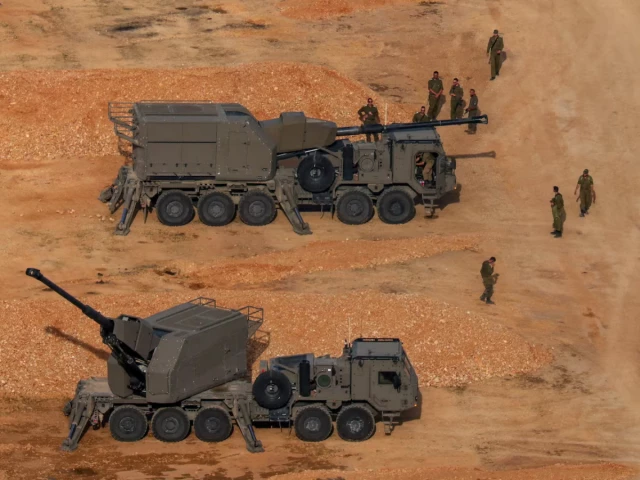
Israeli soldiers next to artillery vehicles near the Israel-Lebanon border, in northern Israel, April 15, 2026. PHOTO: REUTERS
Under a sweeping new legislative proposal, the US Congress is moving to integrate the American and Israeli military forces to an unprecedented degree, in a move that is likely to be deeply problematic, according to a report published on Friday.
The plan to combine the two countries’ military arsenals is embedded in the House of Representatives’ version of the 2027 National Defence Authorisation Act (NDAA) released this Tuesday, said the report by Responsible Statecraft, an online journalistic platform published by the Washington-based Quincy Institute.
Section 224 of the NDAA is devoted to the military integration with the name “United States-Israel Defence Technology Cooperation Initiative,” according to the report, which said the US has contributed an inflation-adjusted $200 billion in military assistance to Israel since 1948.
Responsible Statecraft reported that “Section 224 lays the groundwork for bilateral research and development, co-production of weapons, joint ventures, licensing agreements, and seemingly every manner of US-Israeli military-industrial complex cooperation.”
While both countries have worked jointly on missile defence, the report said the new congressional provision “would greatly expand coordination to seemingly every area of defence tech, including AI, quantum, autonomous systems, directed energy, cyber, biotech,” and also proposes “network integration” and “data fusion,” which would, in essence, combine both countries’ military data.
Read: Pentagon chief says US ready to restart strikes on Iran if no deal
According to the report, if the proposal is approved and fully enacted, it would basically join the American and Israeli military forces at the hip, providing “a higher level of military-industrial integration than the US has with any other country in the world,” which experts believe would benefit the Israeli military more because the US is the number one arms dealer in the world and would be pairing directly with Israel on all weapons, munitions and aircraft, with the US producing the global supply chain of F-35 fighter jets.
Confirming criticism
Much public criticism about the US and Israel working hand-in-hand would be confirmed if the House bill passes and becomes law. According to the report, if that happens, Section 224 “would fuse the US and Israeli defence sectors in multiple areas vital to the battlefields of the future, like autonomous systems and cyber (technologies). It would also bring extraordinary Israeli influence to the US,” beyond the current network of lobbyists and social media influencers.
The report also said that such a collaboration “would give the Israeli government the opportunity to greatly expand one of the most powerful levers of influence in US politics: jobs in the US,” noting that Israel would either expand or start up new co-production facilities like it already has in the states of Alabama and Mississippi.
Experts believe that this type of job influence on US soil could bolster Israel’s political influence and propel the Israeli government to have a say in America’s political decisions by “securing allies among members of Congress who represent the districts where those jobs lie.”
For any country, other than Israel, the US political system would be biased in favor of the Israeli’s government’s decisions, thus justifying what critics have been saying for decades, that the US political system would be even “more susceptible to the whims of an Israeli government that seemingly has no qualms about drawing the US into military conflicts in the Middle East,” according to the report.
Problematic integration
The Responsible Statecraft report warned that the level of US-Israeli military integration could be problematic for the United States.
“The shift will strip away the political and diplomatic oversight mechanisms that make the relationship publicly accountable, moving it from a visible annual aid vote into the opaque machinery of defence acquisition, where oversight is limited and political accountability is minimal. The result would be a defence relationship that is simultaneously deeper and less transparent,” according to the report.
Read More: US judge temporarily blocks Trump’s $1.8 billion ‘weaponisation’ fund
For any US politician or citizen who disagrees with US support of Israel by providing weapons used to conduct deadly airstrikes in Gaza, or the Trump administration’s joint venture with Israel in the war with Iran, Section 224 would provide little recourse for them, since the US and Israel would figuratively be lying in the same bed together, with any opposition having little effect on decision-making.
Fierce debate
The bill is being fiercely debated by lawmakers, with a chasm of opinions that will likely make this a close vote.
“The Democratic Party has provided reflexive and unconditional support to Israeli governments, even as their actions have increasingly undermined American interests and values,” Democratic Sen. Chris Van Hollen told The New York Times.
Republican Rep. Thomas Massie and former Representative Marjorie Taylor Greene have openly decried the Israel lobby as a “corrosive influence” on US policy, a stance political analysts said may have, at least partially, cost both of them their seats in Congress.
While the proposal has yet to be voted on in the House, it comes at a time when a growing number of Americans oppose Israel’s actions in the Middle East, including Israel’s war with Palestine and the US-Israeli joint war with Iran.
Lawmakers will continue hashing out the pros and cons of the bill, which would basically classify the US and Israeli militaries as one and the same.